

In the fast-changing world of financial technology, the ServiceNow $40 million investment in Indian banking- a landmark deal with autonomous platform BusinessNext addresses a massive structural challenge: legacy operational drag. Traditional financial institutions often struggle with fragmented customer data, manual compliance bottlenecks, and slow support turnaround times.
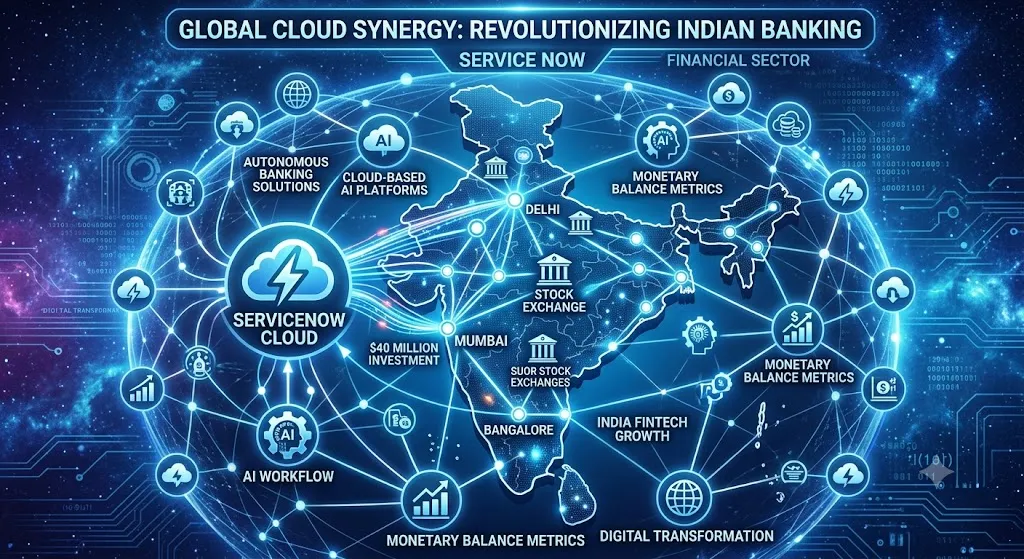
By injecting strategic capital and enterprise AI integration into India’s banking ecosystem, this move accelerates the shift toward automated, secure, and hyper-efficient financial services.
Quick Answer
The ServiceNow $40 million investment in Indian banking strategy centers on ServiceNow Ventures acquiring roughly a 5% stake in Noida-based startup BusinessNext at a $700 million valuation. This deal accelerates AI-driven autonomous banking, expands enterprise workflow automation across India and Asia-Pacific, and strengthens real-time AI governance for major financial institutions.
What Is the ServiceNow $40 Million Investment in Indian Banking?
The ServiceNow $40 million investment in Indian banking initiative marks a major milestone in global enterprise software funding. Through its venture capital arm, ServiceNow Ventures, U.S.-based cloud computing giant ServiceNow secured a ~5% stake in BusinessNext, an Indian banking software provider. This Series B funding round propelled BusinessNext’s valuation to $700 million—nearly four times its previous $181 million valuation in 2021.
BusinessNext, headquartered in Noida, powers autonomous banking tools for over one million bankers across more than 75,000 branches worldwide. Its client roster includes Indian financial heavyweights such as:
- State Bank of India (SBI)
- HDFC Bank
- Axis Bank
- Kotak Mahindra Bank
- IndusInd Bank
- AU Small Finance Bank and Jana Small Finance Bank
Rather than just providing financial backing, ServiceNow is opening up its global go-to-market architecture. This allows BusinessNext to scale its AI-driven lending, customer service, and CRM platforms deeper into Southeast Asia, Australia, and New Zealand.
Why the ServiceNow $40 Million Investment in Indian Banking Matters
India’s banking sector is undergoing a massive digital overhaul. As consumer expectations shift toward instant lending, digital onboarding, and automated dispute resolution, banks must modernize their back-office infrastructure without sacrificing regulatory compliance.
This strategic alignment is critical for three main reasons:
- Bridging Legacy Systems and Modern AI: Banks run on complex, legacy core systems that rarely talk to modern front-end applications. ServiceNow’s workflow capabilities combined with BusinessNext’s domain-specific banking software allow seamless data movement.
- Accelerating Private AI Capabilities: Financial institutions handle highly sensitive customer data. Generic public AI models pose unacceptable data leakage and compliance risks. This deal focuses heavily on deploying “Private AI” models tailored specifically for financial environments.
- Enhancing Productivity per Employee: Bank boards globally are pushing for higher efficiency. Instead of expanding headcount endlessly, autonomous tools empower employees to resolve complex queries while AI handles repetitive administrative work.
For deeper insights on how automated technologies are restructuring the workforce, check out our analysis on whether AI will replace humans or help them.
Key Benefits of the Investment
The partnership brings practical, measurable advantages across technology, operations, and governance:
- Centralized AI Governance: By connecting BusinessNext’s autonomous agents with ServiceNow’s AI Control Tower, banks gain full oversight of model behavior, performance metrics, and safety boundaries.
- Real-Time Compliance Auditing: Regulators increasingly penalize opaque “black box” AI decisions. The combined architecture provides automated, fully auditable logs of every AI agent action.
- Faster Turnaround for Lending and Service: Automated workflow routing slashes loan approval and customer complaint resolution times from days to minutes.
- Expanded Global Reach: BusinessNext gains immediate access to ServiceNow’s worldwide distribution channel, opening fast-track expansion paths in Asia-Pacific markets.
Step-by-Step Guide: How Autonomous Banking Integration Works
Understanding how enterprise AI actually functions inside a modern bank reveals why deals like this create immense long-term value.
Step 1: Query & Request Ingestion
Customer requests arrive across digital channels—mobile banking apps, WhatsApp, web portals, or physical branch desk portals.
Step 2: Intent Classification & Context Mapping
BusinessNext’s Private AI models process the request, identifying user intent (e.g., loan restructuring, credit limit modification, or fraudulent charge report) while retrieving context from core banking databases.
Step 3: Workflow Orchestration
ServiceNow’s enterprise engine orchestrates the required background processes across compliance check systems, risk calculation engines, and account ledgers.
Step 4: AI Agent Action & Governance Check
An autonomous AI agent executes the required operation (or drafts the resolution for human approval). Simultaneous monitoring via the AI Control Tower ensures strict adherence to access controls and privacy laws.
Step 5: Real-Time Audit Logging
Every action, data pull, and decision path is written to an immutable audit trail, keeping the bank compliant with central bank mandates.
Best Practices and Expert Tips for Financial Tech Adoption
If your organization is evaluating enterprise workflow tools or AI integration, keep these practical strategies in mind:
- Prioritize Explainability Over Speed: Never deploy “black box” models in core financial workflows. Ensure your software vendor provides step-by-step reasoning logs.
- Implement Isolated Cloud Environments: Protect consumer records by running AI workloads inside dedicated private instances.
- Start with High-Volume Back-Office Tasks: Begin automating complaint classification, document verification, and internal IT help desks before extending autonomous agents to high-risk wealth management or credit underwriting.
- Enforce Strict Role-Based Access Control (RBAC): AI agents should only access the minimum necessary data fields required to complete a specific action.
Common Mistakes to Avoid in Banking AI Deployment
- Deploying Unmonitored AI Agents: Allowing autonomous agents to perform customer-facing or transactional actions without centralized governance leads to regulatory breaches.
- Neglecting Legacy Integration: Installing slick front-end AI tools that cannot talk to core banking ledgers leads to fragmented customer experiences and manual re-entry errors.
- Underestimating Change Management: Software upgrades fail when branch employees aren’t trained to collaborate with AI assistants.
- Ignoring Local Regulatory Nuances: Financial regulations differ across jurisdictions; global tools must be customized to meet regional compliance standards (such as RBI mandates in India).
Future Trends: What to Expect Next
The ServiceNow $40 million investment in Indian banking event highlights a broader global trend: enterprise software titans are aggressively acquiring stakes in vertical-specific AI leaders.
Over the next few years, expect to see:
- Shift to Real-Time Software Compliance: Auditing will transition from retrospective quarterly reviews to continuous, automated real-time checks.
- Rise of Agentic Banking: Financial tools will move beyond passive chatbots to “agentic workflows” that can autonomously negotiate repayment plans, recalculate mortgage offers, and process claims.
- Hyper-Personalized Micro-Services: Indian banks will leverage Private AI to deliver customized financial products directly to rural and underserved populations at scale.
Final Thoughts
The ServiceNow $40 million investment and Indian banking partnership with BusinessNext is a clear sign that verticalized, compliant AI is the future of enterprise software. By marrying ServiceNow’s global workflow capabilities with BusinessNext’s deep banking expertise, the financial industry gains a blueprint for safe, scalable, autonomous operations.
Whether you are a financial technology enthusiast, an enterprise software developer, or a business strategist, staying informed on these tech shifts is essential. Have questions or want to collaborate on technology analysis? Reach out directly through our Contact Us page or explore our latest posts on TrendCivix!
FAQs
What is the ServiceNow $40 million investment in Indian banking?
It is a $40 million Series B investment made by ServiceNow Ventures into BusinessNext, a Noida-based autonomous banking platform valued at $700 million. The deal aims to scale AI-powered workflows across Indian and global banks.
Which Indian banks use BusinessNext software?
BusinessNext powers banking solutions for major Indian lenders, including State Bank of India (SBI), HDFC Bank, Axis Bank, Kotak Mahindra Bank, IndusInd Bank, and AU Small Finance Bank.
How does this deal benefit artificial intelligence in banking?
The deal integrates BusinessNext’s banking platform with ServiceNow’s AI Control Tower, giving banks enhanced visibility, real-time auditing, and governance over autonomous AI agents.
Why is Private AI important for financial institutions?
Private AI ensures that sensitive customer records and financial data remain isolated within secure enterprise environments, preventing data leaks while keeping banks fully compliant with financial regulations.
What regional markets will BusinessNext expand into following this deal?
With ServiceNow’s global go-to-market structure, BusinessNext is expanding its presence across Southeast Asia, Australia, and New Zealand.