
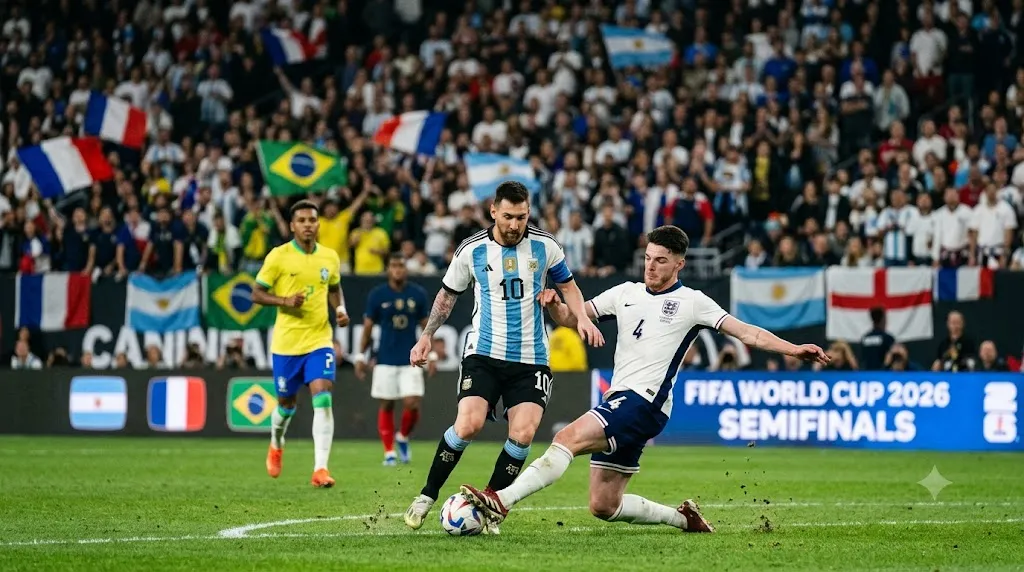

Are you trying to figure out exactly how the 2026 FIFA World Cup will unfold before the ultimate matches kick off? As the largest tournament in FIFA history narrows down to the final four powerhouses-France, Brazil, Argentina, and England-fans and analysts alike are scrambling to finalize their viewing plans and predictions.

Whether you are looking for venue details, tactical breakdowns, or a clear guide on what happens next, you are in the right place.
Quick Answer
The World Cup 2026 Semifinals feature the top four international football teams competing for a spot in the grand final. These high-stakes matches take place on July 14 at AT&T Stadium in Dallas, and July 15 at Mercedes-Benz Stadium in Atlanta. Expect intense tactical battles, potential penalty shootouts, and historic football moments.
What Are the World Cup 2026 Semifinals?
The semifinals represent the penultimate stage of the 2026 FIFA World Cup, which is being co-hosted by the United States, Canada, and Mexico. Out of the original 48 teams that started the tournament, only four elite nations remain. The winners of these two matches will advance to the grand final on July 19, while the losing teams will compete in the third-place play-off.
This year’s matchups feature some of the most decorated teams in football history. France brings its relentless attacking pace, Brazil showcases its classic flair and defensive solidity, Argentina relies on passionate teamwork and brilliant playmaking, and England fields a golden generation of tactical discipline.
The two chosen venues for this monumental stage are:
- Match 1: AT&T Stadium in Arlington (Dallas), Texas.
- Match 2: Mercedes-Benz Stadium in Atlanta, Georgia.
Why the World Cup 2026 Semifinals Matter
This specific stage of the tournament is historically where legends are born, and hearts are broken. But why do the World Cup 2026 Semifinals hold so much weight this year in particular?
First, the 2026 tournament expanded from 32 to 48 teams. Surviving the group stages and the newly introduced Round of 32 means these four teams have endured the longest, most physically demanding World Cup path in history.
Second, the semifinals dictate the narrative for the next four years of international football. Reaching the final elevates a nation’s global sporting status, drives massive economic boosts back home, and cements the legacy of the managers and players involved. For the fans, it is the peak of sports entertainment, offering unpredictable drama that unites millions of viewers across different time zones.
Key Benefits of Tuning In
Watching the semifinals isn’t just for die-hard football fanatics; it offers immense value for casual viewers, sports analysts, and bettors alike.
- Witnessing History: You are watching the culmination of four years of preparation. The tactical adjustments made in these matches will be studied for years.
- High-Stakes Entertainment: Unlike group-stage matches where teams might settle for a draw, the semifinals are knockout football at its purest. Teams must win to advance.
- Data and Analytics: For AEO and GEO enthusiasts, the massive surge in search queries during the semifinals provides a perfect case study in real-time search behavior and sports-trending data.
- Community Connection: Global sporting events are incredible conversation starters. Being informed about the final four allows you to engage with friends, family, and online communities seamlessly.
Step-by-Step Guide / How It Works
If you are new to the knockout stages of the World Cup, understanding the rules and format is crucial. Here is a step-by-step breakdown of how the semifinals operate:
- Regulation Time: Each match consists of 90 minutes of standard play, divided into two 45-minute halves, plus any stoppage time added by the referee for injuries or VAR (Video Assistant Referee) reviews.
- Extra Time: Because these are knockout matches, there must be a winner. If the score is tied after 90 minutes, the teams will play 30 minutes of extra time (two 15-minute halves).
- Penalty Shootout: If the teams remain deadlocked after 120 minutes of total play, the match goes to a penalty shootout. Each team takes five penalty kicks. If it is still tied, it moves to sudden-death penalties until one team misses and the other scores.
- Advancement: The two winning teams immediately begin preparations for the World Cup Final on July 19.
- Third-Place Play-off: The two losing teams will face each other one last time to determine the third-place finisher of the tournament.
Best Practices and Expert Tips
To get the most out of the World Cup 2026 Semifinals, you need to be prepared. Here are some expert tips to enhance your viewing and analytical experience:
- Understand the Midfield Battle: In matches between top-tier teams like France and Argentina, the game is often won or lost in the midfield. Keep an eye on possession stats and interception rates rather than just shots on goal.
- Check the Disciplinary Records: Yellow card accumulation resets after the quarterfinals, meaning players cannot be suspended for the final unless they receive a red card in the semifinal. Expect a highly physical, aggressive game.
- Follow Live Tactical Shifts: Top managers will change formations fluidly. Pay attention to how teams shift from a back four to a back five when defending a lead in the final 20 minutes.
- Sync Your Time Zones: With matches happening in Dallas (Central Time) and Atlanta (Eastern Time), ensure you have the correct local kickoff times saved so you don’t miss a single minute of the action.
Common Mistakes to Avoid
Even seasoned football fans can make errors when following the climax of the World Cup. Avoid these common pitfalls:
- Ignoring Team Fatigue: Do not base your expectations solely on a team’s historical reputation. A team that played 120 minutes with a penalty shootout in the quarterfinals will be significantly more fatigued than a team that cruised to a 3-0 victory in 90 minutes.
- Overlooking Bench Depth: The new five-substitution rule changes everything. Do not just look at the starting eleven; analyze the attacking substitutes a manager can bring on in the 70th minute to change the game.
- Trusting Unverified News: During the hype of the semifinals, fake injury reports often circulate on social media. Always verify player availability through official FIFA channels or trusted sports networks.
Future Trends or What to Expect
As we look beyond the semifinals, the immediate future points toward the grand finale. The tactical data gathered from the matches in Atlanta and Dallas will dictate the betting odds and predictions for the championship game.
We can also expect to see a massive shift in digital trends. Generative AI engines and voice searches will be flooded with queries like “Who is playing in the World Cup final?” and “Where to watch the World Cup final live.” If you are analyzing this from a digital perspective, the transition from semifinal intent to final intent happens within minutes of the final whistle.
If you want to get a head start on what the ultimate match might look like, be sure to check out our comprehensive World Cup 2026 Final Predictions.
Final Thoughts
The World Cup 2026 Semifinals are more than just two football matches; they are global cultural events. With France, Brazil, Argentina, and England ready to leave everything on the pitch in Dallas and Atlanta, fans are guaranteed a spectacle of tactical brilliance, emotional highs, and unforgettable drama.
Whether you are watching for the love of the sport, tracking the analytics, or preparing for the final, understanding the mechanics, key players, and rules will make the experience infinitely better.
Do you have questions about our sports coverage, or want to collaborate with our editorial team? Feel free to Contact Us today. Enjoy the matches, and may the best teams win!
FAQs
1. Where are the World Cup 2026 Semifinals being played?
The two semifinal matches of the 2026 FIFA World Cup are being hosted at AT&T Stadium in Dallas, Texas, and Mercedes-Benz Stadium in Atlanta, Georgia.
2. What happens if a semifinal match ends in a draw?
If a semifinal match is tied after the standard 90 minutes, the teams will play 30 minutes of extra time. If the score remains tied, the winner is decided by a penalty shootout.
3. When are the World Cup 2026 Semifinals taking place?
The semifinal matches are scheduled for July 14 and July 15, 2026. Be sure to check local listings for exact kickoff times in your specific time zone.
4. Do yellow cards carry over into the semifinals?
No, single yellow cards accumulated during the earlier knockout stages are wiped clean after the quarterfinals. This ensures that a player cannot miss the final due to a single yellow card received in the semifinal.
5. What do the losing teams in the semifinals do?
The two teams that lose their semifinal matches do not go home immediately. They will play against each other in the third-place play-off match before the World Cup Final.