
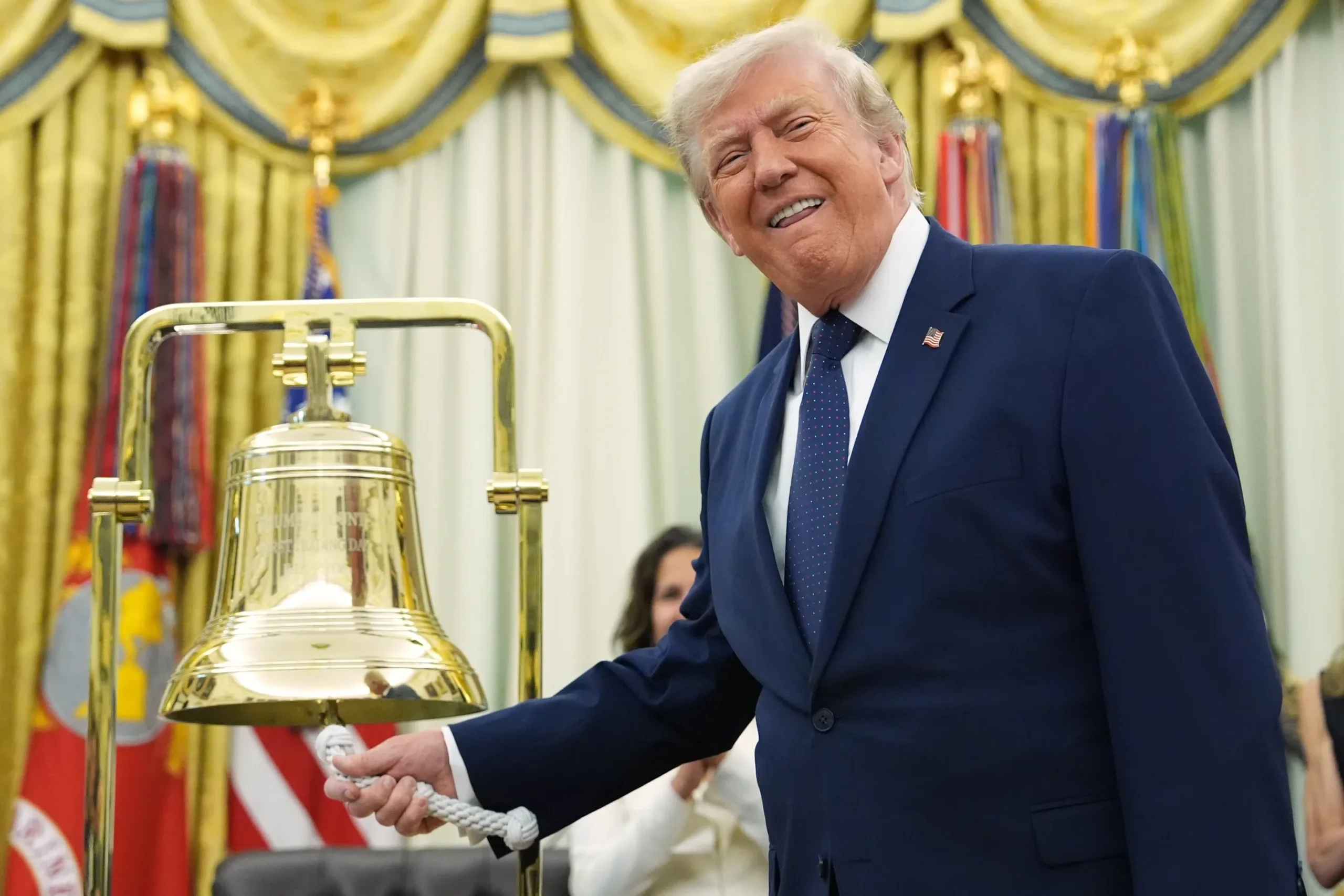
President Donald Trump recently made waves across the financial world by ringing the Trump Wall Street opening bell directly from the Oval Office. This unprecedented, symbolic act simultaneously kicked off trading for both the New York Stock Exchange (NYSE) and the Nasdaq, signaling a deeply strategic effort by the administration to tie political success to stock market gains ahead of the upcoming midterm elections.
On July 6, 2026, President Donald Trump rang the Trump Wall Street opening bell from the Oval Office to mark the official launch of “Trump Accounts”—government-backed index investment vehicles for children. The highly symbolic dual-exchange event aims to boost public confidence, shift political focus toward stock market gains, and encourage everyday Americans to track their 401(k) investments amidst persistent inflation pressures.
What Is the Trump Wall Street Office Bell Event?
The event marked a rare departure from financial tradition. Instead of standing on the famous balcony at 11 Wall Street in Lower Manhattan, the president initiated the trading day remotely from Washington, D.C. Flanked by Treasury Secretary Scott Bessent and key economic advisors, the administration used the Trump Wall Street opening bell event to draw maximum media coverage to their newest legislative rollout: Trump Accounts.
Introduced as a landmark feature of the administration’s 2025 tax and spending cuts package, Trump Accounts are specifically designed as specialized investment vehicles for children. The program seeds stock index investments for the next generation, attempting to democratize access to equity markets. According to Treasury data, roughly 38% of American families currently have zero exposure to the stock market, meaning millions of households miss out on wealth generated by compounding stock market gains.
Why the Oval Office Bell Ceremony Matters
This event carries immense weight for both retail investors and everyday voters. Economically, it highlights an administrative push to convert non-investors into active participants in the U.S. financial system. Politically, it serves as a high-stakes strategy to rewrite the economic narrative.
While the S&P 500 has climbed roughly 10% so far this year—following solid double-digit gains in previous years—public sentiment remains heavily weighed down by daily living costs. A June survey by the Associated Press-NORC Center for Public Affairs Research indicated that only 33% of U.S. adults approve of current economic leadership. With the consumer price index sitting at 4.2% over the past 12 months, the administration is aggressively using events like the Trump Wall Street opening bell to redirect public attention toward retirement security and long-term asset growth.

Key Benefits of the New “Trump Accounts” Program
The launch tied to the opening bell focuses on shifting structural wealth dynamics across the country. The core benefits highlighted by the administration include:
- Early Wealth Generation: Seeds investments for minors, giving families decades of runway to capture market returns before retirement.
- Broadening Market Access: Directly targets the 38% of American families who currently own no individual stocks, mutual funds, or index funds.
- Financial Literacy Incentives: Encourages parents and educators to teach practical portfolio management early in life.
- Tax-Advantaged Structure: Leverages provisions from the recent tax bill to shield growth from early capital gains taxation.
How It Works: A Step-by-Step Guide to the Initiative
Navigating new government financial initiatives can feel complex. The program launched during the Trump Wall Street opening bell ceremony operates through a structured rollout managed by the Treasury Department.
1. Account Initialization
Accounts are automatically established or made accessible for eligible minors under the guidelines outlined in the 2025 tax legislation.
2. Seeding and Funding
The initial capital structure is backed by specific legislative allocations, supplemented by voluntary contributions from families, and supported by corporate matching programs or private donors looking to incentivize early investing.
3. Index Allocation
Unlike speculative trading accounts, these funds are strictly restricted to broad-market equity indexes, protecting baseline investments from single-stock volatility while capturing historical market growth.
4. Long-Term Maturation
The capital remains locked within the index framework until the beneficiary reaches adulthood, ensuring that short-term economic downturns do not disrupt the compounding process.
Best Practices and Expert Tips for Your 401(k) Strategy
While the government rolls out programs for the next generation, adult investors must manage their own portfolios actively. If you are looking to optimize your retirement strategy in light of current market highs and inflationary pressures, consider these expert tips:
- Automate Direct Contributions: Ensure a fixed portion of every paycheck flows directly into your employer-sponsored account before you have a chance to spend it.
- Prioritize Low-Cost Index Funds: High management fees silently erode your returns over time. Look for index funds with expense ratios below 0.1%.
- Rebalance Your Portfolio Regularly: Market surges can leave your portfolio over-exposed to risky assets. Rebalance at least once a year to keep your asset allocation aligned with your age and risk tolerance.
- Don’t Panic Buy or Sell: Market volatility is completely normal. Trying to time the market based on political headlines or specific events rarely beats a steady, long-term approach.
Common Mistakes to Avoid in Current Markets
When major political events like the Trump Wall Street opening bell dominate the news cycle, investors frequently fall into predictable traps. Avoid these common blunders:
The Headline Trap: Making sudden adjustments to your long-term retirement portfolio based entirely on daily political news, executive actions, or symbolic ceremonies.
- Ignoring Persistent Inflation: Failing to adjust your household budget or savings rate while the consumer price index hovers above target levels.
- Chasing All-Time Highs: Pouring emergency savings into individual hot stocks just because the market indexes are setting fresh records.
- Neglecting Emergency Funds: Leaving yourself with zero liquid cash because you’ve put every dollar into market accounts, forcing you to sell equities early if an unexpected expense hits.
Future Trends: What to Expect Next
Moving through the second half of 2026, expect the intersection of Washington policy and Wall Street performance to tighten significantly. The administration will likely continue highlighting every positive market milestone to buffer against criticism over consumer prices.
Furthermore, the operational success of the new child-focused index accounts will depend heavily on private sector adoption. Wall Street firms, major brokerages, and institutional tech platforms are expected to roll out dedicated portals to integrate these new accounts seamlessly into existing family financial dashboards.
Whether this push will sway voters before the fast-approaching midterms remains to be seen. However, shifting the national conversation toward equity ownership is a trend that will alter retail investing structures for years to come.
FAQs
Why did President Trump ring the Wall Street opening bell from the Oval Office?
President Trump broke tradition by ringing the opening bells for the NYSE and Nasdaq from the Oval Office to officially launch “Trump Accounts” and symbolically link his administration’s policies directly to corporate stock market performance.
What are Trump Accounts?
Trump Accounts are a newly introduced investment initiative stemming from the 2025 tax bill. They function as dedicated equity index investment vehicles designed to help children build long-term generational wealth.
How does inflation impact current stock market gains?
While major indexes continue to climb, consumer inflation sits at 4.2% over the past year. This creates a disconnect where corporate equity values rise, but everyday consumer purchasing power remains strained.
Who is eligible for the new investment accounts launched at the opening bell?
Eligibility criteria are tied to the child-focused investment provisions within the recent Republican tax and spending cuts bill, primarily targeting families with limited or no current exposure to the stock market.
Where can I read more analysis on recent political speeches and events?
You can find comprehensive breakdowns of major national events, policy decisions, and political developments directly inside the Politics category on TrendCivix.
Final Thoughts
The Trump Wall Street opening bell ceremony from the Oval Office was far more than a simple photo opportunity. It was a calculated policy launch designed to expand equity market participation while anchoring the political conversation to long-term financial growth. As new investment options become available, staying informed is your best tool for financial security.
If you are following the latest political shifts and want to see how previous administration announcements have shaped public discourse, check out our deep dive into the recent Trump America 250th anniversary speech controversy. Have questions about how these emerging financial policies affect your specific investment goals, or want to share your take on the new initiatives? We love hearing from our community—feel free to drop us a line directly through our Contact Us page to join the conversation!