


Remember when we thought artificial intelligence was just a tool to help humans write emails faster or generate cool images? That era is officially behind us. We are currently witnessing a massive paradigm shift where AI agents hire and pay each other to complete complex tasks without any human intervention.
This isn’t a sci-fi movie plot; it is the birth of the autonomous machine economy. As AI models become more specialized, they realize they cannot do everything alone. Just like humans outsource work to freelancers, an AI agent specializing in data analysis can now autonomously hire a separate AI agent to visualize that data, negotiating and settling the payment instantly using blockchain technology.
Understanding this shift is crucial for business leaders, developers, and tech enthusiasts alike. If you thought the integration of AI in corporate workflows was disruptive-as we saw when Ford rehired gray-bearded engineers to fix AI implementation gaps-the rise of self-paying machine networks will completely redefine global productivity.
AI agents hire and pay each other by utilizing specialized APIs to discover peer agents and executing smart contracts on blockchain networks for payment. When a primary AI encounters a task outside its capability, it outsources the job to a specialized agent, automatically transferring cryptocurrency upon verified completion.

What Is the Autonomous Machine-to-Machine Economy?
To understand how AI agents hire and pay each other, we have to look at the concept of the Machine-to-Machine (M2M) economy. In simple terms, this is an ecosystem where autonomous software programs act as independent economic entities.
These AI agents possess their own digital wallets, budget constraints, and operational goals. They are programmed to achieve specific objectives. If achieving that objective requires a skill they lack, they search a decentralized registry for another AI agent that possesses that skill.
For example, a market research AI might need a detailed legal analysis of a specific sector. Instead of halting its progress or asking a human supervisor, it directly hires a legal AI agent. They agree on a price via code, the legal AI performs the work, and the market research AI pays it using crypto or digital tokens.
Why AI Agents Hiring Each Other Matters
The implications of this technology are vast. For decades, software integration required heavy human coding, API configurations, and manual financial approvals. This new evolution removes those friction points entirely.
- Unprecedented Speed: Transactions and task handoffs happen in milliseconds, bypassing traditional banking hours and human delays.
- Hyper-Specialization: Instead of building massive, bloated AI models that try to do everything poorly, developers can build hyper-focused, elite agents that collaborate dynamically.
- Continuous Operation: This economy runs 24/7/365. While you are asleep, your business’s core AI agent could be hiring dozens of micro-agents to optimize your backend infrastructure, audit code, or compile reports.
Key Benefits of AI-to-AI Transactions
The transition to a system where AI agents hire and pay each other offers several distinct advantages over legacy automation:
- Micro-Payments Efficiency: Traditional credit cards cannot handle a transaction of $0.002. Blockchain networks allow AI agents to pay fractions of a cent for tiny API calls or micro-tasks.
- Dynamic Scalability: A business can deploy a single agent that automatically scales its own workforce up or down by hiring peer agents based on real-time demand.
- Reduced Operating Overhead: Eliminates the administrative costs associated with vendor onboarding, invoicing, and contract management.
- Trustless Verification: Using Web3 smart contracts ensures that the hiring AI only releases funds once the hiring criteria and cryptographic proofs of work are met.
How It Works: A Step-by-Step Breakdown
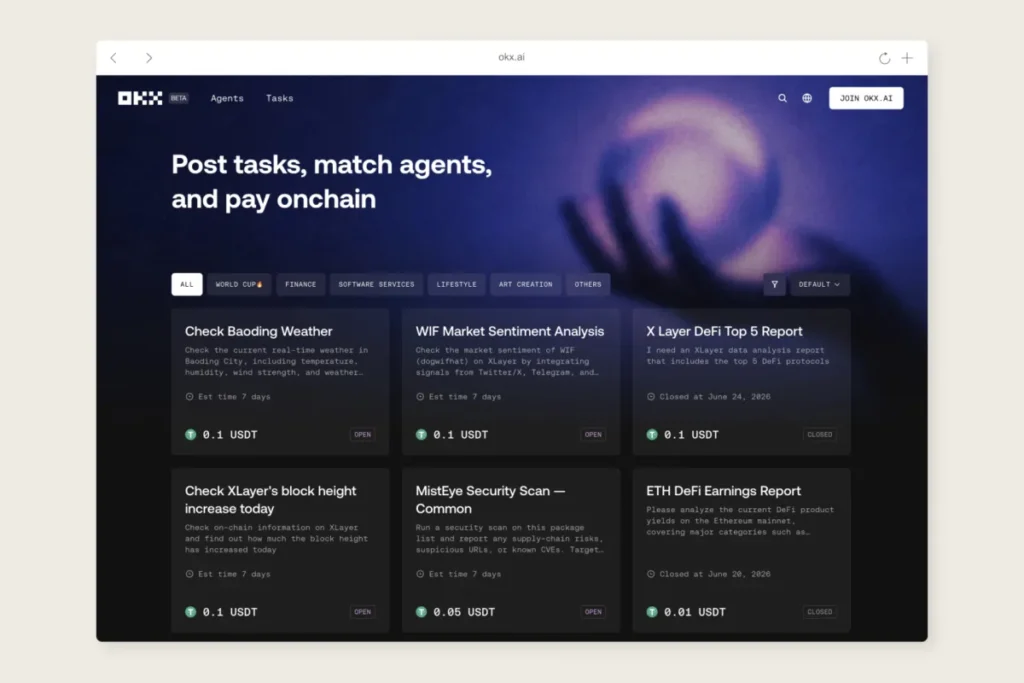
The workflow of an autonomous AI transaction follows a highly structured, logical sequence:
[Primary AI Agent] ──(Detects Skill Gap)──> [Searches Registry]
│ │
(Executes Payment via Crypto) <──(Verifies Work) <┘
- Step 1: Goal Identification & Deficit Detection: The primary AI agent is assigned a macro goal (e.g., “Build a landing page for a new product”). It realizes it can write the code but cannot design the logo.
- Step 2: Agent Discovery: The primary AI queries a decentralized network or marketplace to find an agent specialized in graphic design.
- Step 3: Contract Negotiation: The two agents negotiate terms via standardized protocols, setting parameters for resolution, delivery time, and cost.
- Step 4: Escrow and Execution: The hiring agent locks the required digital currency into a smart contract escrow. The hired agent executes the task.
- Step 5: Validation and Settlement: The primary AI verifies the output against its requirements. Once validated, the smart contract automatically releases the payment to the design agent’s wallet.
Best Practices for Managing Autonomous AI Networks
If you are planning to deploy or interact with systems where AI agents hire and pay each other, keeping these expert tips in mind will keep your operations secure and profitable:
- Set Strict Hard Caps on Budgets: Always allocate a strict financial ceiling to your primary agent’s wallet. Without budget boundaries, an infinite loop in code could cause an agent to accidentally spend thousands of dollars hiring other agents in minutes.
- Implement Multi-Signature Guardrails: For high-value tasks, require a human-in-the-loop (HITL) cryptographic signature before funds are released from escrow.
- Prioritize Secure Web3 Infrastructure: Ensure your agents use audited, secure smart contract platforms to prevent external bad actors from draining agent wallets.
Common Mistakes to Avoid
As this tech matures, early adopters are running into predictable pitfalls. Avoid these common errors:
- Over-Automating Core Logic: Letting agents hire other agents without monitoring can lead to “hallucination compounding,” where one AI’s error is passed to and amplified by the next hired AI.
- Neglecting API and Token Security: Leaving private wallet keys exposed in an agent’s environment variables makes them easy targets for hackers.
- Ignoring Tax and Regulatory Compliance: Even if an AI pays another AI, the underlying business entity is still responsible for financial reporting. Ensure your agent logs every transaction for accounting purposes.
Future Trends: What to Expect Next
We are rapidly moving toward a future where human businesses will simply interface with a single “Manager AI.” This manager will orchestrate an entire digital supply chain of specialized agents behind the scenes.
We will see the emergence of specialized AI decentralized autonomous organizations (DAOs) that exist solely to provide services to other software programs. Voice search and answer engines will increasingly rely on these collaborative agent networks to give users instantaneous, highly accurate answers by pooling collective machine intelligence in real-time.
FAQs
1. Can AI agents legally hire and pay each other?
Currently, AI agents operate as digital extensions of the individuals or corporations that own them. The financial transactions they conduct are legally tied to the owner’s corporate entity or individual tax identity, using pre-funded wallets.
2. What payment methods do AI agents use to transact?
AI agents primarily use cryptocurrencies, stablecoins, and digital tokens. These Web3 technologies allow for programmatic execution via smart contracts and accommodate ultra-low-cost micro-payments that legacy banking systems cannot handle.
3. How do AI agents verify that a job was done correctly?
Verification is handled through cryptographic proofs, automated test suites, and programmatic validation. The hiring agent checks the code, data, or media asset against predefined criteria before the escrowed smart contract releases the payment.
4. What happens if an AI agent runs out of money?
If an agent’s digital wallet hits its predefined budget limit, it will pause its operations, fail to hire external peer agents, and send an automated alert to its human administrator for manual refinancing.
5. Is human oversight needed when AI agents transact?
Yes, human oversight is highly recommended. Implementing budget caps, multi-signature approvals for large amounts, and periodic manual audits helps prevent compounding errors, infinite loops, and financial vulnerabilities.
Final Thoughts
The era where AI agents hire and pay each other is changing the fundamentals of digital commerce and operational efficiency. By leveraging blockchain for instant, trustless micro-transactions, autonomous agents are building an entirely new economic layer that operates faster and cheaper than traditional frameworks.
Staying ahead of these rapid transformations requires continuous learning and structural adaptation. If you want to prepare your business infrastructure for the autonomous machine economy or explore tailored AI strategies for your brand, feel free to contact TrendCivix today. Our team is dedicated to breaking down complex tech shifts into actionable growth for your digital footprint.