
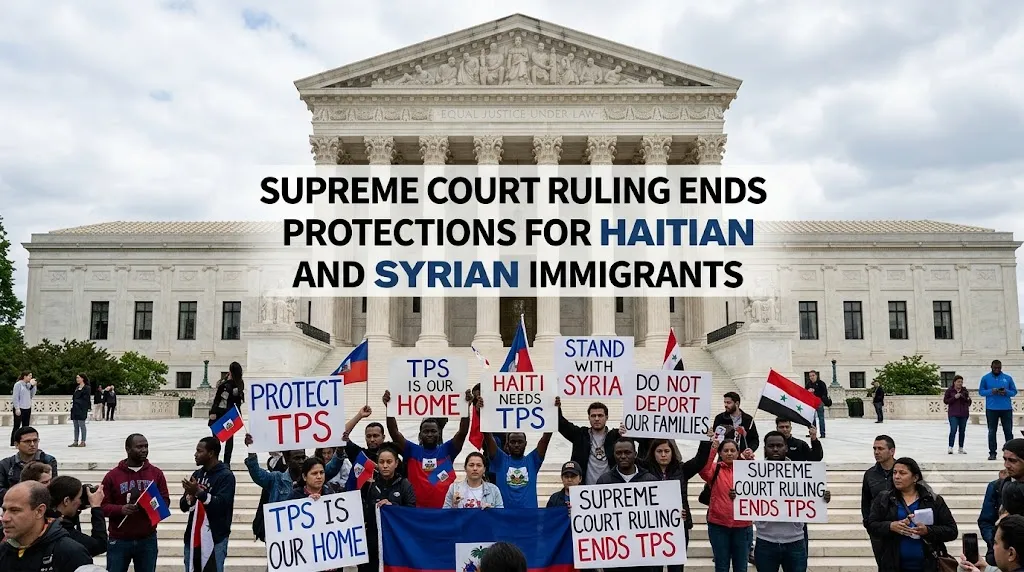
Recent developments show that the Supreme Court TPS Ruling has triggered one of the most profound tectonic shifts in American immigration policy in decades. In a highly anticipated 6–3 decision, the U.S. Supreme Court fundamentally redefined the limits of executive power over humanitarian relief programs. By greenlighting the termination of legal shields for hundreds of thousands of individuals, the highest court has sent shockwaves through immigrant communities, corporate boardrooms, and legal circles alike..
For years, many foreign nationals living in the United States have relied on temporary administrative protections to build lives, raise families, and fill vital roles in the domestic economy. This recent judicial breakthrough strips away those safeguards for specific groups and sets a legal precedent that effectively insulates executive immigration decisions from courtroom challenges. Understanding the depth of this ruling is critical for affected families, employers, and advocacy groups.
The Supreme Court’s 6–3 ruling in Mullin v. Doe allows the executive branch to terminate Temporary Protected Status (TPS) for roughly 350,000 Haitians and over 6,000 Syrians. By ruling that federal law bars judicial review of non-constitutional TPS determinations, the decision strips work authorizations and opens the door for wide-scale future rollbacks.
What Is Temporary Protected Status (TPS)?
Temporary Protected Status (TPS) is a humanitarian program established by Congress under the Immigration Act of 1990. It grants temporary legal status, protection from deportation, and employment authorization documents (EADs) to foreign nationals already inside the United States whose home countries are suffering from catastrophic conditions.
According to the statutory framework, the Secretary of the Department of Homeland Security (DHS) can designate a country for TPS based on three primary triggers:
- Ongoing Armed Conflict: Such as an active civil war that poses a serious threat to personal safety.
- Environmental Disasters: Including earthquakes, hurricanes, or epidemics that temporarily leave the state incapable of handling the return of its nationals.
- Extraordinary and Temporary Conditions: Any volatile circumstance preventing safe repatriation.
TPS is explicitly designed as a temporary lifeline—not a direct path to a green card or permanent citizenship. However, because conditions in countries like Haiti (following the devastating 2010 earthquake and subsequent political crises) and Syria (following the outbreak of civil war in 2012) remained hazardous for years, consecutive administrations repeatedly extended these protections.
Why the Supreme Court TPS Ruling Matters
The Supreme Court’s decision in Mullin v. Doe matters immensely because it shifts the balance of power entirely to the executive branch regarding humanitarian immigration.
Previously, when the executive branch attempted to scale back or end TPS designations for various countries, federal judges routinely stepped in. Lower courts frequently halted terminations, ruling that administrative agencies failed to follow proper procedures—such as conducting objective interagency reviews of country conditions—or that decisions were improperly motivated.
The Supreme Court has now completely removed that judicial safety net. Writing for the conservative majority, Justice Samuel Alito clarified that the explicit wording of the original 1990 TPS statute strips federal courts of the jurisdiction to review the DHS Secretary’s non-constitutional “determinations” regarding terminations. In short, the judiciary can no longer review whether the executive branch followed proper administrative procedures when pulling the plug on a country’s protected status.
The Major Takeaway: This ruling does not just impact Haitians and Syrians; it establishes a precedent that insulates future TPS revocations for any country from being challenged or delayed in court.
Key Benefits of the Program That Are Now at Risk
For decades, the protections provided by TPS offered multi-layered benefits to both the recipients and the American communities they integrated into. The dismantling of these protections puts several critical pillars at risk:
- Legal Protections from Removal: Beneficiaries could live without the persistent fear of sudden detention and deportation to highly unstable homelands.
- Lawful Employment Authorization: TPS holders received official work permits, allowing them to gain clean employment, pay income taxes, and build careers.
- Economic Stability for Essential Sectors: Major American industries rely heavily on this workforce. For example, healthcare groups have repeatedly warned that thousands of Haitian nurses, home health aides, and medical assistants will face immediate job loss.
- Socioeconomic Contributions: TPS families have bought homes, opened small businesses, and contributed billions of dollars to state and local tax bases.
Step-by-Step Guide: How the Ruling Rollout Works
The transition from legally protected status to vulnerability will not happen overnight, but the operational runway is short. The process moves through distinct legal and logistical stages:
1. Lower Court Injunctions Lifted -> 2. Federal Register Publication -> 3. Expiration of Work Permits -> 4. Status Reversion or Departure
1. Dissolution of Lower Court Stays
The immediate consequence of the high court’s 6-3 ruling is the formal lifting of all lower-court injunctions that previously barred the government from ending these protections.
2. Official Agency Notices
The Department of Homeland Security, through the Federal Register, formalizes the exact winding-down timelines. While specific dates vary based on previous administrative planning, the wind-down windows provide a strict countdown for affected individuals.
3. Expiration of Work Authorization
Once the designated wind-down period hits its deadline, employment authorization documents (EADs) held by covered Haitian and Syrian nationals automatically become invalid. Employers are legally required to conduct Form I-9 reverifications.
4. Reversion to Previous Immigration Status
When TPS officially expires, individuals automatically revert to the immigration status they held prior to receiving TPS—unless they successfully adjusted their status in the interim. For the vast majority, this means returning to an undocumented status, making them subject to removal proceedings.
Best Practices and Expert Tips for Affected Individuals
If you or a loved one is currently a TPS beneficiary impacted by this ruling, taking proactive, orderly steps is essential.
Audit Your Immigration History Immediately
Do not wait for your current work permit to expire. Schedule a comprehensive consultation with a licensed immigration attorney or a Department of Justice (DOJ)-accredited representative. You need an individualized evaluation to see if you qualify for alternative pathways to lawful status.
Explore Alternative Relief Avenues
Determine if you are eligible for other forms of immigration benefits that may run parallel to your TPS, including:
- Family-Based Adjustment of Status: If you have an immediate relative (spouse or adult child over 21) who is a U.S. citizen.
- Employment-Based Visas: Some employers may be willing to sponsor high-skilled workers, though navigating this from within the country can be complex.
- Asylum or Withholding of Removal: If you possess a well-founded fear of persecution based on race, religion, nationality, political opinion, or membership in a particular social group if returned home.
Communicate Openly with Your Employer
Keep an open line of communication with your employer’s HR department. Ensure they are aware of your current authorization dates and discuss how the company handles transitional periods or potential status updates.
Common Mistakes to Avoid
During periods of sweeping policy changes, misinformation spreads rapidly. Avoid these critical pitfalls to protect your future:
- Falling Victim to “Notario” Scams: Only trust licensed attorneys or DOJ-accredited organizations. Unregulated document preparers or “notarios” often make false promises, steal money, and submit fraudulent filings that cause permanent deportation.
- Ignoring Filing Deadlines: If you have an active application for a different status (such as a pending asylum claim or a family visa petition), ensure all documentation is filed on time and addresses are kept current with USCIS.
- Assuming Automatic Extensions: Do not assume that public outcry or shifting political tides will result in a sudden extension. Treat the published deadlines as fixed and unyielding.
Future Trends: What to Expect Next
The broader implications of Mullin v. Doe stretch far past the immediate borders of the Haitian and Syrian communities. Legal experts warn that this decision marks the beginning of what could be the largest “de-documentation” effort in modern U.S. history.
| Affected Country Group | Approximate U.S. Beneficiaries | Estimated Legal Risk Level |
| Venezuela | 600,000+ individuals | High (Targeted for termination) |
| El Salvador | 200,000+ individuals | High (Decades-long protections vulnerable) |
| Ukraine | 50,000+ individuals | Moderate to High (Subject to administrative review) |
| South Sudan & Somalia | Various cohorts | High (Litigation protections dismantled) |
Because the Supreme Court ruled that judicial review is barred for these statutory decisions, the administration now holds a blank check to systematically dismantle TPS designations for all remaining countries. Barring a major legislative intervention from Congress, hundreds of thousands of long-term residents are facing an impending loss of legal status over the coming months.
FAQs
What did the Supreme Court rule regarding TPS for Haiti and Syria?
The Supreme Court ruled 6–3 that the executive branch has the unreviewable authority to terminate Temporary Protected Status (TPS) for Haiti and Syria, deciding that federal courts lack jurisdiction to hear non-constitutional lawsuits challenging how these administrative terminations are decided.
Can Haitian and Syrian immigrants on TPS be deported immediately?
Not immediately. The government implements a transitional wind-down period specified in the Federal Register. However, once those specific administrative grace periods expire, individuals lose their deportation shields and work permits unless they secure an alternative legal status.
How does this Supreme Court ruling affect immigrants from other countries?
The ruling strips away the ability of immigrants from any country to use federal courts to block a DHS decision to end their TPS. This exposes hundreds of thousands of long-term TPS holders from nations like Venezuela and El Salvador to future status revocations.
Can an employer keep employing a TPS holder after the status expires?
No. Once the wind-down period ends and a TPS-based Employment Authorization Document (EAD) expires, it is illegal under federal law for an employer to retain that worker without proof of a different, valid work authorization.
Can Congress step in to reverse the effects of this ruling?
Yes. Because TPS is a creation of statutory law passed by Congress, lawmakers hold the legislative power to pass bills granting permanent residency or statutory extensions to affected individuals, though achieving the necessary legislative consensus remains highly challenging.
Final Thoughts
The Supreme Court’s immigration ruling underscores a stark reality: executive humanitarian programs are inherently fragile and subject to shifting political tides. For hundreds of thousands of Haitian and Syrian families who have legally contributed to American communities for years, the path forward has suddenly become incredibly uncertain.
As the federal government prepares to execute these terminations, staying informed, obtaining legitimate legal counsel, and acting swiftly are your best lines of defense. If you have questions about how these policy shifts affect your community, or if you need resources to navigate these legal updates, don’t hesitate to reach out. Please visit our TrendCivix Contact Page to connect with our team, share your perspective, or explore our comprehensive archives on evolving political and legal landscapes.