
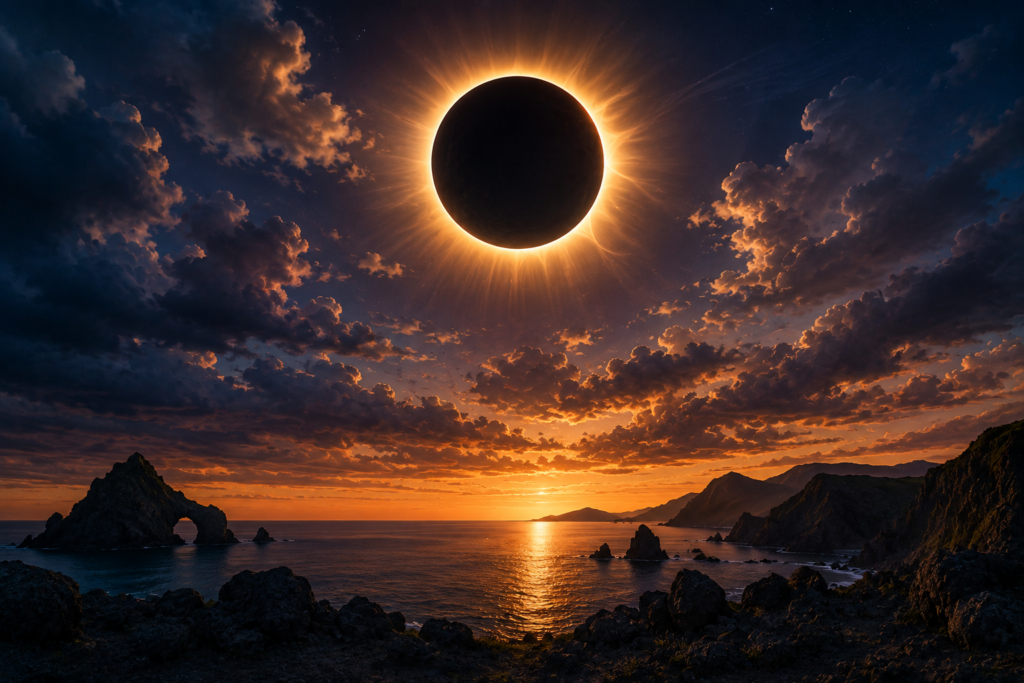

The highly anticipated Solar Eclipse August 2026 is finally here, giving millions of people across Europe, North America, Africa and the North Atlantic region a chance to witness one of nature’s most spectacular astronomical events.
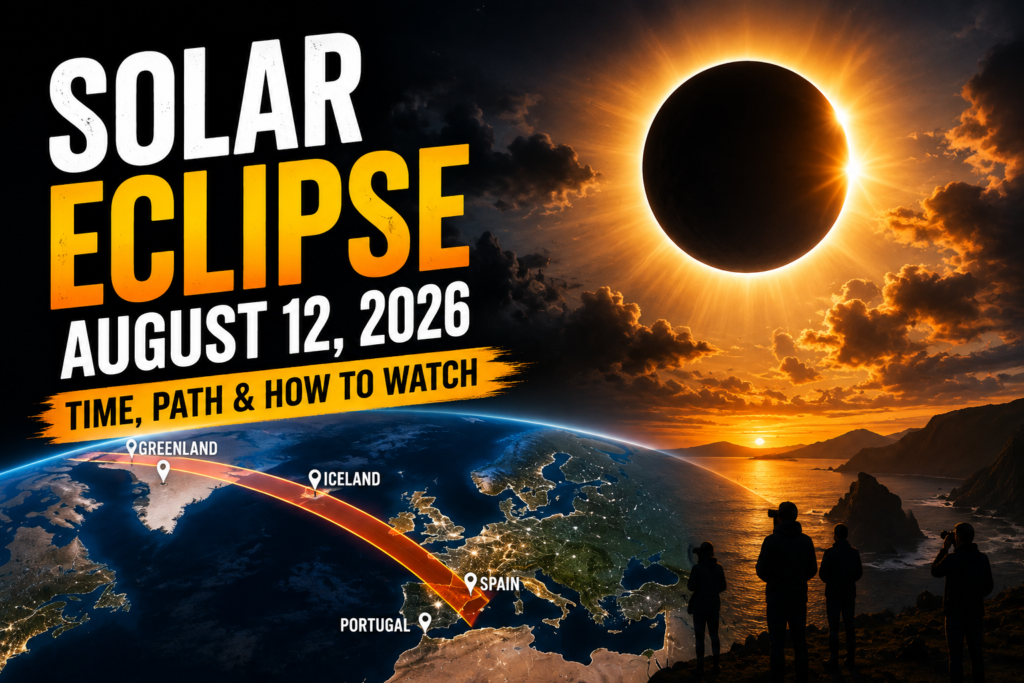
On August 12, 2026, the Moon will move directly between Earth and the Sun, creating a total solar eclipse along a narrow path while surrounding regions experience a partial eclipse.
For people inside the path of totality, daylight will briefly turn into darkness as the Moon completely covers the Sun. Outside that path, observers may still see a significant portion of the Sun blocked by the Moon.
The event has attracted astronomers, photographers, travelers and skywatchers around the world, with some of the best viewing locations located in Greenland, Iceland and Spain.
Here’s everything you need to know about the August 12, 2026 solar eclipse, including its path, timing, visibility, best viewing locations and important eye-safety precautions.
For more trending science, technology and global stories, explore the latest updates on Tren dCivix.
What Is the Solar Eclipse August 2026?
The August 12, 2026 solar eclipse is a total solar eclipse.
A total solar eclipse happens when the Moon passes between Earth and the Sun and appears large enough in the sky to completely cover the Sun’s bright surface.
During the brief period known as totality, observers located inside the narrow path of totality can see the Sun’s outer atmosphere, known as the corona.
The surrounding sky becomes noticeably darker and the temperature may temporarily drop.
However, people outside the path of totality will experience a partial solar eclipse, meaning only part of the Sun will be covered.
According to NASA, the path of the August 2026 total solar eclipse crosses several regions across the Northern Hemisphere.
When Is the Solar Eclipse in August 2026?
The eclipse occurs on:
Date: Wednesday, August 12, 2026
The exact eclipse time depends entirely on your location.
Because the Moon’s shadow moves across the Earth, people in different countries and cities experience the eclipse at different local times.
For example, totality reaches parts of Spain during the evening, while partial phases are visible earlier or later in other regions.
People planning to watch the eclipse should therefore check local eclipse timings rather than relying on a single global time.
Solar Eclipse August 2026 Path
The solar eclipse 2026 path stretches across a large portion of the Northern Hemisphere.
NASA confirms that totality crosses:
- Northern Russia
- Greenland
- Iceland
- Atlantic Ocean
- Spain
- A small corner of Portugal
People directly inside this narrow region can potentially experience a total solar eclipse, assuming weather conditions allow clear viewing.
A much larger surrounding area experiences a partial eclipse.
This includes large parts of Europe, northern North America and northwestern Africa.
Where Can You See the Total Solar Eclipse?
Some of the most discussed locations for viewing the August 12 2026 total solar eclipse are Iceland and Spain.
Iceland
Western Iceland falls within the eclipse’s path of totality.
The country’s dramatic landscapes have made it particularly attractive for eclipse travelers and photographers.
Depending on the exact viewing location and weather, observers may witness the Sun completely disappearing behind the Moon.
Spain
Northern Spain is another major eclipse-viewing destination.
A large portion of northern Spain falls inside the path of totality, giving residents and visitors an opportunity to experience one of Europe’s most important astronomical events in decades.
Totality occurs close to sunset in parts of Spain, potentially creating a visually dramatic eclipse.
Greenland
Parts of eastern Greenland are also inside the path of totality.
Although remote, Greenland provides another location where observers can potentially see the Sun completely covered.
Portugal
A small northeastern section of Portugal is also touched by the path of totality.
Most of Portugal, however, experiences the event as a partial eclipse.
Solar Eclipse August 2026 in Spain
Spain has become one of the most important locations for the 2026 eclipse.
According to eclipse timing information, the partial eclipse begins in Spain during the evening, with totality occurring at approximately 8:26 p.m. CEST in parts of the country.
Exact times vary by location.
Because the Sun is relatively low in the sky at that time, observers need a viewing location with a clear western horizon.
Mountains, tall buildings and other obstacles could potentially block the view.
The evening timing also creates opportunities for photographers hoping to capture the eclipse near the horizon.
Can You See the Solar Eclipse in the UK?
Yes, but observers in the United Kingdom experience a partial solar eclipse rather than totality.
The partial eclipse begins in the UK at approximately 5:59 p.m. BST, although exact timing varies according to location.
In some western and northern areas, a very large portion of the Sun can be covered.
This means the eclipse can still appear impressive even though viewers in the UK will not experience complete darkness caused by totality.
People across Britain should use proper eclipse glasses throughout the event.
Is the Solar Eclipse Visible in the United States?
Parts of the United States can see a partial solar eclipse on August 12, 2026.
The path of totality does not cross the continental United States.
However, parts of the northern U.S. can experience varying levels of partial eclipse.
NASA lists portions of the U.S., stretching from Alaska toward parts of the eastern states, among the areas where the partial eclipse may be visible.
Visibility depends heavily on geographic location and local weather.
Is the Eclipse Visible in Canada?
Much of Canada falls within the partial eclipse visibility zone.
Different areas see different percentages of the Sun covered by the Moon.
Northern and eastern regions can generally experience stronger eclipse coverage than locations farther from the Moon’s shadow.
Again, observers should check exact local eclipse maps and timings before viewing.
Why Is the August 2026 Eclipse Special?
The Solar Eclipse August 2026 is particularly important for Europe.
It marks the first total solar eclipse visible from mainland Europe since 1999.
That long gap has increased interest from eclipse enthusiasts around the world.
Many people have traveled to Iceland and Spain specifically to experience the event.
The 2026 eclipse is also part of an interesting period for European astronomy.
Another total solar eclipse will cross parts of Spain on August 2, 2027, while an annular solar eclipse will affect parts of Portugal and Spain in January 2028.
What Happens During a Total Solar Eclipse?
A total solar eclipse progresses through several stages.
Initially, the Moon begins covering one edge of the Sun.
This is known as the partial phase.
As the Moon moves farther across the Sun, sunlight gradually decreases.
For observers inside the path of totality, the Moon eventually covers the entire bright surface of the Sun.
During this short period:
- The sky becomes dramatically darker.
- Bright planets and stars may become visible.
- Temperatures can fall.
- Animals may react as though evening has arrived.
- The Sun’s corona becomes visible around the dark Moon.
After totality ends, the process happens in reverse as the Moon slowly moves away from the Sun.
How Long Does Totality Last?
The length of totality depends on the observer’s exact position.
Locations closer to the center of the eclipse path generally experience longer totality than places near the edge.
For the August 12 eclipse, some locations can experience totality lasting around two minutes.
Although this may sound brief, witnessing even a minute of totality can be an extraordinary experience.
How to Watch the Solar Eclipse Safely
Eye safety is one of the most important considerations when watching a solar eclipse.
Never look directly at the Sun without proper eye protection during partial eclipse phases.
Normal sunglasses are not sufficient.
Instead, viewers should use certified solar eclipse glasses or approved handheld solar viewers designed specifically for direct solar observation.
Safe options include:
- ISO-compliant eclipse glasses
- Certified handheld solar viewers
- Solar filters designed specifically for telescopes
- Pinhole projection methods
Cameras, binoculars and telescopes require their own solar filters attached to the front of the optical device.
Looking through an optical device while wearing ordinary eclipse glasses can still cause serious eye damage because the lenses concentrate sunlight.
Can You Look at the Sun During Totality?
Only observers inside the path of totality may briefly view the Sun without eclipse glasses when the Sun is completely covered by the Moon.
The moment any bright portion of the Sun becomes visible again, eye protection must immediately be used.
People experiencing only a partial eclipse should never remove their solar viewers while looking directly at the Sun.
How to Photograph the August 2026 Solar Eclipse
Solar eclipses create incredible photography opportunities, but cameras also require protection.
Photographers should use an appropriate solar filter over the front of the lens during partial phases.
A tripod can help create sharper images, particularly when using telephoto lenses.
Other useful equipment can include:
- Telephoto lens
- Solar photography filter
- Tripod
- Remote shutter
- Extra batteries
- Memory cards
Photographers should also consider capturing the surrounding landscape and crowd reactions rather than focusing entirely on close-up images of the Sun.
Solar Eclipse August 2026 Live Stream
People who cannot see the eclipse from their location can still follow the event online.
NASA is providing official live eclipse coverage featuring views from locations along the eclipse path and commentary from experts.
Online streams can be particularly useful for people living outside the eclipse visibility zone or in locations affected by clouds.
NASA’s official eclipse resources are available through NASA Eclipse Information.
The European Space Agency is also providing information and coverage through ESA.
Detailed city-by-city eclipse timing and interactive maps are available through Timeanddate.
What If the Weather Is Cloudy?
Cloud cover is one of the biggest challenges for eclipse observers.
Even inside the path of totality, thick clouds can completely block the Sun.
People traveling to see the eclipse often monitor local weather conditions and maintain backup viewing locations.
However, even when clouds block a direct view, observers may still notice the dramatic change in daylight caused by totality.
Online live streams also provide an alternative if local weather conditions prevent direct viewing.
Is Another Solar Eclipse Coming Soon?
Yes.
Europe will experience another major eclipse relatively soon.
A total solar eclipse occurs on August 2, 2027, crossing regions including Spain and parts of North Africa.
That eclipse is expected to offer particularly impressive totality in some locations.
There will also be an annular solar eclipse on January 26, 2028, visible from parts of Europe and other regions.
For more science and technology stories, visit the AI & Technology section of TrendCivix.
Why Solar Eclipse August 2026 Is Trending
Search interest around solar eclipse August 2026 has surged because the event is happening on August 12.
People are searching for:
- Eclipse timings
- Solar eclipse paths
- Live streams
- Best viewing locations
- Eclipse glasses
- Spain eclipse time
- UK eclipse visibility
- U.S. eclipse visibility
- Weather forecasts
Search demand typically becomes strongest immediately before and during an eclipse.
That makes real-time information especially valuable for people trying to decide when and where to watch.
Final Thoughts
The Solar Eclipse August 2026 is one of the biggest astronomical events of the year.
On August 12, the Moon’s shadow crosses Greenland, Iceland, northern Russia, Spain, Portugal and the North Atlantic, producing totality along a narrow path.
Millions more people across Europe, Canada, parts of the United States and northwestern Africa can witness a partial eclipse.
Whether you’re watching from Spain, Iceland, the UK, Canada or online, remember that proper eye protection is essential throughout all partial phases.
For observers lucky enough to stand inside the path of totality, the brief moment when the Moon completely covers the Sun could become an unforgettable experience.
Follow TrendCivix for more trending science, technology and entertainment updates.
FAQs About Solar Eclipse August 2026
What date is the solar eclipse in August 2026?
The total solar eclipse occurs on Wednesday, August 12, 2026.
Where is the August 2026 solar eclipse total?
Totality crosses parts of northern Russia, Greenland, Iceland, Spain and a small section of Portugal.
Can the UK see the August 12, 2026 eclipse?
Yes. The UK experiences a partial solar eclipse, but it is outside the path of totality.
Can the United States see the eclipse?
Parts of the United States experience a partial solar eclipse. Totality is not visible from the continental U.S.
What time is the solar eclipse in Spain?
The exact time depends on location, but totality begins around 8:26 p.m. CEST in parts of Spain.
Can I watch a solar eclipse with sunglasses?
No. Regular sunglasses do not provide enough protection. Use certified solar eclipse glasses or an approved solar viewer.
Where can I watch the solar eclipse online?
NASA is providing official live coverage of the August 12, 2026 total solar eclipse.