
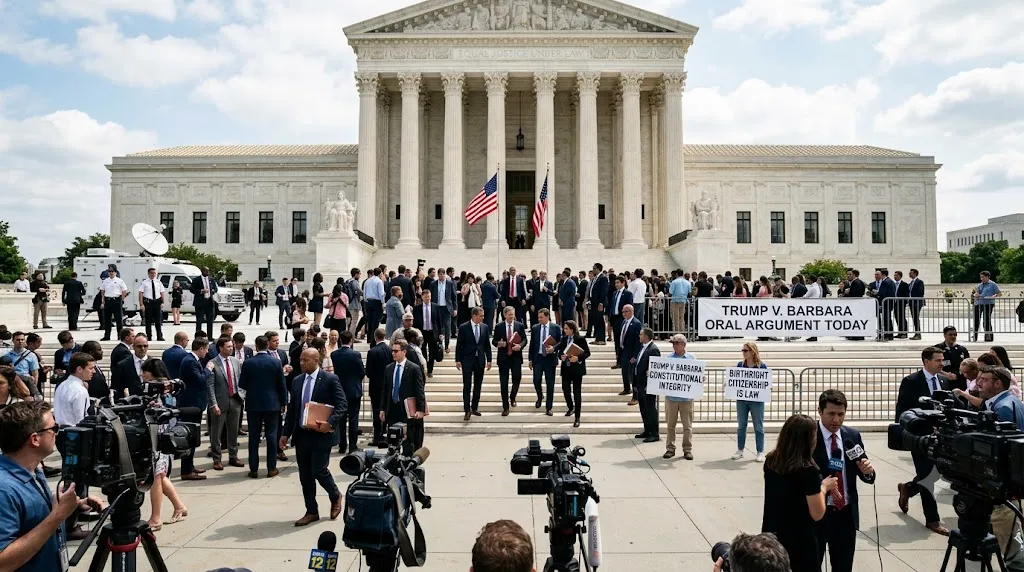
The United States is currently witnessing one of the most defining legal battles of the 21st century. On April 1, 2026, the Supreme Court heard the historic Trump v. Barbara oral argument. This monumental case sits at the intersection of executive power, immigration policy, and constitutional law, directly challenging a century-old consensus on who gets to be an American citizen.
The core dispute stems from January 20, 2025, when President Donald J. Trump signed Executive Order 14160, titled “Protecting the Meaning and Value of American Citizenship.” This order directed federal agencies to halt the automatic recognition of birthright citizenship for children born on U.S. soil if their mothers are unlawfully present or holding temporary visas, and if their fathers are neither citizens nor lawful permanent residents. This policy fundamentally alters how the federal government applies the Fourteenth Amendment, making the Trump v. Barbara oral argument a focal point for lawmakers, immigrants, and legal scholars worldwide.
What is the Trump v. Barbara oral argument about?
The Trump v. Barbara oral argument is the Supreme Court review of Executive Order 14160, which attempts to end automatic birthright citizenship for children of undocumented immigrants and temporary visa holders. The case decides if a president can redefine the Fourteenth Amendment’s Citizenship Clause or if citizenship is permanently guaranteed by birth on U.S. soil.
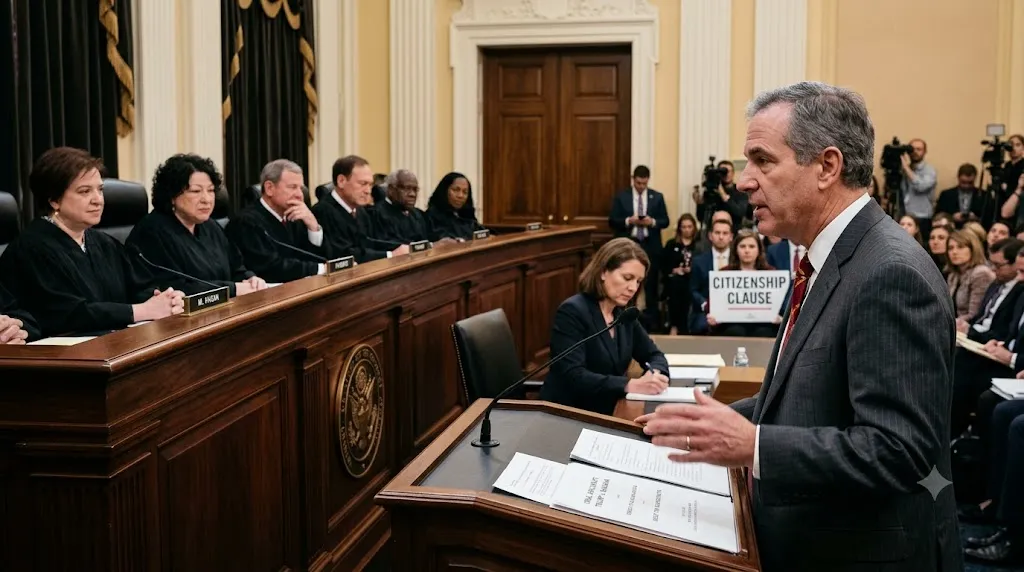
What Is Trump v. Barbara?
Trump v. Barbara (Docket No. 25-365) is a high-stakes federal lawsuit brought before the Supreme Court of the United States during its October 2025–2026 term. The lawsuit was filed on behalf of a certified class of affected families. The lead respondent, “Barbara,” is a pseudonymous Honduran asylum seeker expecting a child, joined by other families including temporary visa holders whose children’s document applications were disrupted by the administration’s mandate.
The primary legal question is whether an executive order can strip or withhold birthright citizenship from children born in the United States based on their parents’ immigration status. Historically, the U.S. has operated under the principle of jus soli (right of the soil), meaning almost anyone born within the physical borders of the United States is automatically a citizen. By bypassing the lower appellate courts via a mechanism called certiorari before judgment, the Supreme Court accelerated this case to settle whether Executive Order 14160 complies with the U.S. Constitution and federal immigration statutes.
Why the Trump v. Barbara Oral Argument Matters
The live-streamed proceedings on April 1, 2026, carried immense political and legal weight. For the first time in official records, a sitting president—Donald Trump—attended a portion of the Supreme Court oral arguments in person, underscoring the priority his administration places on this structural shift.
This case matters profoundly because it tests the limits of executive power. If the Court rules in favor of the administration, it marks a massive departure from how the country has functioned for generations. Millions of future children born within U.S. borders could find themselves undocumented, creating a multi-tiered system of citizenship determined by parental lineage rather than geography. Conversely, a ruling against the administration would firmly cement birthright citizenship as an absolute constitutional right that cannot be altered without a formal constitutional amendment or specific congressional action.
Key Legal Issues in the Case
The entire case revolves around a few specific words in the U.S. Constitution and existing legal precedents. Understanding these points helps clarify why the justices asked such pointed questions during the Trump v. Barbara oral argument:
- The Citizenship Clause: Section 1 of the Fourteenth Amendment reads: “All persons born or naturalized in the United States, and subject to the jurisdiction thereof, are citizens of the United States…” The legal fight is over what “subject to the jurisdiction thereof” actually means.
- The Statutory Codification: Federal law under 8 U.S.C. § 1401(a) explicitly codifies this constitutional clause. Challengers argue the President cannot override an Act of Congress through an executive decree.
- The Precedent of Wong Kim Ark: The landmark 1898 Supreme Court ruling in United States v. Wong Kim Ark held that a child born in San Francisco to Chinese citizens was a U.S. citizen at birth. For over 125 years, this case has been viewed as the definitive affirmation of territorial birthright citizenship.
- The Scope of Injunctions: The case also touches on federal court procedures, following previous complex battles regarding when and how regional district courts can issue nationwide injunctions against executive actions.
How It Works: The Main Arguments Compared
During the intense sessions of the Trump v. Barbara oral argument, the legal teams presented fundamentally opposing interpretations of American history and constitutional syntax.
The Trump Administration’s Position
Represented by U.S. Solicitor General D. John Sauer, the government argued that “subject to the jurisdiction thereof” implies a requirement of complete, political allegiance to the United States, rather than just being subject to everyday regulatory laws. The administration contends that:
- True allegiance requires a “lawful domicile” (a permanent, legally recognized home) within the country.
- Undocumented immigrants and temporary visitors maintain primary allegiance to foreign powers.
- The original public intent of the Fourteenth Amendment in 1868 was meant to secure citizenship for newly freed slaves, not to grant it unconditionally to foreign nationals who enter the country temporarily or unlawfully.
The Respondents’ Position
Represented by Cecillia Wang of the American Civil Liberties Union (ACLU), the families and their legal allies asserted that the Constitution is plain and unambiguous. Their argument hinges on the following:
- “Subject to the jurisdiction” simply means being bound by U.S. laws. Anyone walking on U.S. soil can be arrested, taxed, and prosecuted, meaning they are fully under U.S. jurisdiction.
- The historical exceptions to birthright citizenship are incredibly narrow, limited only to children of foreign diplomats, sovereign ministers, or invading foreign armies.
- Over 40 amici curiae (friend-of-the-court) briefs submitted by legal scholars, labor unions, and civil rights groups emphasize that jus soli has been an unbroken pillar of American stability and human dignity.
Best Practices and Expert Insights for Following the Case
As the legal community awaits a final opinion from the high court, staying accurately informed requires looking past hyperbole. Legal analysts recommend keeping these expert tips in mind:
- Read the Official Transcripts: Avoid highly partisan summaries. The Supreme Court publishes full audio and text transcripts of the Trump v. Barbara oral argument directly on its official website.
- Watch the Domicile Debate: Pay close attention to how the justices discuss “domicile.” During arguments, several conservative and liberal justices voiced practical skepticism about how federal agencies would determine a parent’s “intent to remain permanently” at the exact moment a baby is born.
- Differentiate Executive Orders from Amendments: Remember that this case evaluates whether an executive order can interpret the text this way. It is a debate over executive boundaries just as much as it is about immigration.
Common Misconceptions to Avoid
Due to the sensationalized nature of immigration debates, several common errors frequently appear in public discussions regarding the Trump v. Barbara oral argument:
- Misconception 1: “The Supreme Court has already decided the issue.”
- The Reality: The Court has only ruled on preliminary procedural issues regarding lower-court injunctions. The core constitutional question of birthright citizenship remains pending adjudication as of mid-2026.
- Misconception 2: “This order will retroactively strip citizenship from living people.”
- The Reality: The Trump administration has explicitly stated that Executive Order 14160 applies prospectively to children born after the order’s implementation window. It does not strip citizenship from individuals who already hold it.
- Misconception 3: “The U.S. is the only country with birthright citizenship.”
- The Reality: While it is true that many European countries do not practice unrestricted jus soli, unconditional birthright citizenship is common across the Americas, including Canada, Mexico, and Brazil.
What to Expect Next
The Supreme Court is expected to issue its blockbuster ruling before the end of its current summer term in 2026. Legal experts are closely reading the tea leaves from the Trump v. Barbara oral argument to anticipate the outcome.
If the Court upholds Executive Order 14160, federal agencies will immediately roll out stringent new criteria for passport applications, social security numbering, and birth certificates, requiring parents to verify their lawful permanent residency or citizenship status. If the Court strikes down the order, it will deal a permanent blow to executive-led attempts to restrict birthright citizenship, ensuring the policy remains intact unless a structural change occurs at the legislative or constitutional amendment level.
FAQs
What is the primary focus of the Trump v. Barbara case?
The case focuses on whether President Trump’s Executive Order 14160, which restricts automatic birthright citizenship for children of undocumented immigrants and temporary visa holders, violates the Fourteenth Amendment of the U.S. Constitution.
When did the Trump v. Barbara oral argument take place?
The Supreme Court heard the official oral arguments for the case on April 1, 2026.
What is the 14th Amendment’s Citizenship Clause?
The Citizenship Clause states that all persons born or naturalized in the United States, and subject to the jurisdiction thereof, are automatically citizens of the United States and the state where they reside.
How does the Wong Kim Ark case relate to Trump v. Barbara?
The 1898 United States v. Wong Kim Ark ruling established that children born on U.S. soil to foreign citizens are automatic birthright citizens. Challengers in Trump v. Barbara argue this landmark precedent completely invalidates the current executive order.
Will a decision in Trump v. Barbara affect existing U.S. citizens?
No. The Trump administration has clarified that the executive order operates prospectively, meaning it only targets specific categories of children born after the order’s effective date and does not affect existing citizens.
Final Thoughts
The Trump v. Barbara oral argument is a generational crossroad for American jurisprudence. Whether the Supreme Court favors a strict territorial application of the Fourteenth Amendment or adopts the administration’s allegiance-driven model, the social and legal landscape of the United States will be reshaped for decades to come.
As political shifts and global policy agreements continue to influence domestic landscapes, keeping up with these critical transformations is essential. To read more about foundational legal changes or international agreements impacting domestic policies, review our analysis of the Islamabad Memorandum. If you have questions about our legal analysis or want to share your insights on current political trends, feel free to visit our website and contact TrendCivix directly.