
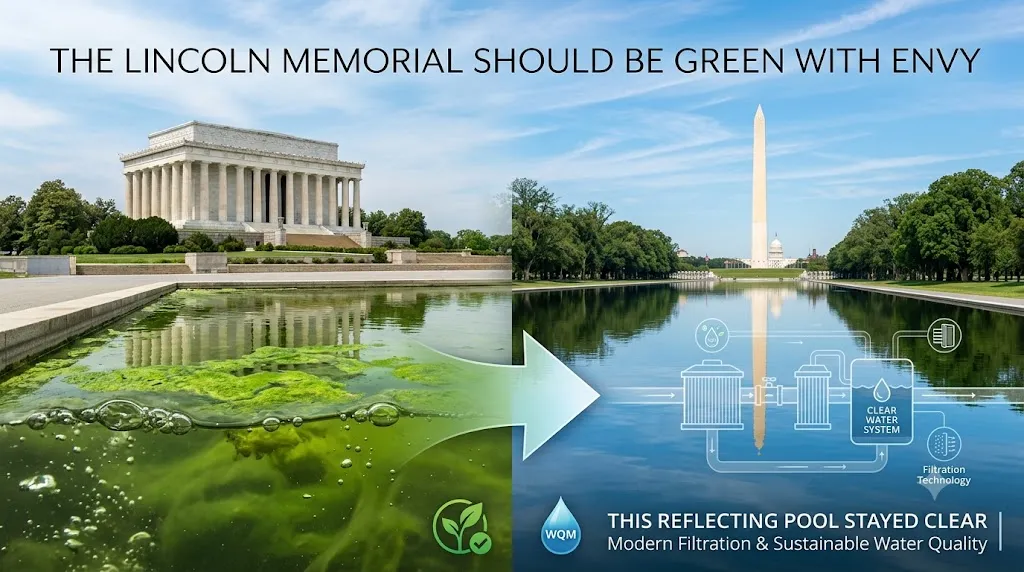
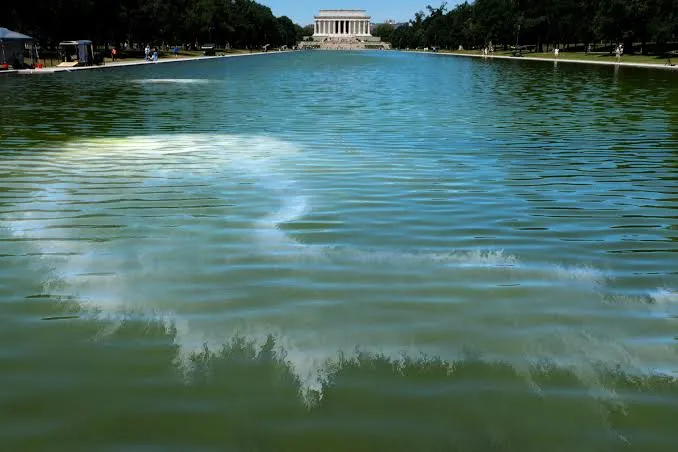
If you have ever strolled down the National Mall in Washington, D.C., you know that the view stretching from the Lincoln Memorial to the Washington Monument is iconic. However, during hot summer months, that view has historically faced a recurring, murky problem: a massive, bright green algae bloom.
When stagnant water meets blazing summer heat and high nutrient levels, nature takes its course, transforming a national treasure into what looks like a giant bowl of pea soup. This aesthetic and environmental challenge leaves city planners, park rangers, and environmentalists asking a critical question: How do we keep massive, historic urban water bodies clean and clear without destroying local ecosystems?
Fortunately, innovative engineering and modernized eco-friendly management are paving the way for clearer water.
The Lincoln Memorial Reflecting Pool manages its water quality through a modernized, continuous filtration system installed by the National Park Service (NPS). By circulating water from the nearby Tidal Basin, filtering impurities with ozone, and using eco-friendly treatments rather than harsh chemical dumps, the pool minimizes algae blooms and remains sustainably clear.
What Is the Reflecting Pool Water Quality System?
The Lincoln Memorial Reflecting Pool water quality system is a specialized, large-scale civil engineering setup designed to clean, circulate, and maintain approximately 6.75 million gallons of water.
Historically, the pool operated on a simple “fill and drain” model. The National Park Service (NPS) would fill the basin with domestic drinking water, let it sit, and then dump it into the city’s sewer system when it became too dirty.
Today, the modern infrastructure relies on a continuous loop filtration facility housed underground. This system draws water, filters out particulate matter, sterilizes pathogens, and pumps it back into the pool to ensure continuous movement. By eliminating stagnation, the system drastically cuts down the primary environment where algae thrives.
Why Urban Water Management Matters
Maintaining large public pools and lakes isn’t just about preserving beautiful backdrops for tourist photos—though that is a multi-million-dollar economic driver for Washington, D.C. It is an issue deeply intertwined with public health, local political accountability, and urban environmental policy.
When large water bodies become stagnant, they turn into breeding grounds for disease-carrying mosquitoes and toxic cyanobacteria (blue-green algae). Furthermore, dumping millions of gallons of chemically treated or stagnant water into local rivers stresses municipal wastewater infrastructure. Just as political decisions regarding immigration or civil rights—such as the legal frameworks discussed in our coverage of the Supreme Court TPS ruling—affect community infrastructure, how a capital city manages its physical resources sets a benchmark for national standards. Sustainable water management proves that government-run infrastructure can adapt to climate pressures efficiently.
Key Benefits of Sustainable Filtration

Upgrading from archaic water-dumping methods to a closed-loop or semi-closed-loop filtration system provides several structural advantages:
- Massive Water Conservation: Re-circulating water saves tens of millions of gallons of potable city water every single year.
- Reduction in Chemical Runoff: Relying on physical filtration and ozone disinfection decreases the need for heavy chlorine dumps, protecting local waterways from chemical pollution.
- Cost Efficiency: Over time, filtering and circulating existing water is far cheaper than continuously purchasing treated municipal water to refill the basin.
- Habitat Protection: Keeping the water clear and moderately balanced prevents toxic runoff from seeping into the surrounding soil, preserving the roots of the historic elm trees lining the Mall.
How It Works: The Step-by-Step Cleansing Process
Keeping 6.75 million gallons of water pristine without relying on pool chemicals requires a highly systematic process.
1. Water Sourcing and Intake: Phase 1.
Water is drawn into the system, historically utilizing water from the nearby Tidal Basin or municipal supplies, ensuring the pool stays at optimal levels despite evaporation.
2. Debris and Micro-Screen Filtration: Phase 2.
The water passes through large mechanical screens and pressurized sand filters. This phase removes leaves, dirt, trash, and large particulate matter that contain algae-feeding nutrients.
3. Ozone Disinfection: Phase 3.
Instead of using massive quantities of chlorine, the system uses ozone gas ($\text{O}_3$). Ozone is a powerful, fast-acting oxidizer that destroys organic compounds, bacteria, and algae spores on contact without leaving harmful chemical residues.
4. Continuous Circulation: Phase 4.
Pumps return the purified water into the pool through multiple inlet nozzles, creating a steady, subtle current. This constant movement prevents the thermal stratification (warm surface layers) that algae need to bloom.
Best Practices and Expert Tips for Large-Scale Water Feature Maintenance
Whether you are managing a massive municipal landmark or a localized community pond, experts highlight several universal best practices for preventing water degradation:
The Golden Rule of Water Quality: Nutrient management is more effective than chemical eradication. If you cut off the supply of phosphorus and nitrogen, algae cannot grow.
- Monitor Temperature and Sunlight: Algae blooms spike when water temperatures climb. Utilizing deeper basin designs or introducing subtle aeration helps cool the lower depths of the water.
- Deploy Eco-Friendly Bio-Blends: When minor blooms occur, eco-friendly water managers use specialized, non-toxic microbes that safely consume the excess nutrients before algae can take hold.
- Regular Skimming: Organic matter like leaves and bird droppings act as fertilizer. Daily mechanical skimming prevents these items from decaying and dissolving into the water column.
Common Mistakes to Avoid
- Over-Chlorinating Open Systems: Heavy chemical dumping can create toxic vapors in open public spaces and decimate local wildlife if the water leaks or is discharged.
- Ignoring Bottom Sediment: Left alone, organic muck builds up at the bottom of a pool. Even with clear surface water, this sediment acts as a ticking time bomb of nutrients that can trigger a sudden bloom.
- Neglecting Equipment Calibrations: Filtration pumps and ozone generators must be calibrated continuously based on seasonal weather patterns and crowd sizes.
Future Trends in Eco-Friendly Infrastructure
As global temperatures rise, urban centers are experiencing longer, hotter summers. This reality is forcing water management strategies to evolve rapidly.
We are beginning to see the integration of solar-powered ultrasonic algae control devices, which emit sound waves that shatter the internal structure of algae cells without harming fish or plants. Additionally, many cities are turning to automated, AI-driven sensor networks that monitor real-time nutrient loads, predicting an algae bloom days before it becomes visible to the naked eye. This allows engineers to adjust filtration cycles proactively.
FAQs
Why does the Lincoln Memorial Reflecting Pool turn green?
The pool turns green due to seasonal algae blooms. High summer temperatures, stagnant water, intense sunlight, and organic nutrients (like bird droppings or runoff) create the perfect environment for algae to multiply rapidly.
How does the National Park Service clean the Reflecting Pool?
The National Park Service cleans the pool using an underground filtration system that continuously circulates the water. The system pumps the water through sand filters and treats it with ozone disinfection to eliminate organic impurities and algae spores without heavy chemical use.
Does the Reflecting Pool use chlorine?
The system relies primarily on mechanical filtration and ozone treatment rather than chlorine. This eco-friendly method avoids releasing heavy chemical residues into the surrounding urban environment and local river systems.
How deep is the Lincoln Memorial Reflecting Pool?
The reflecting pool is relatively shallow, with a depth that slopes from approximately 18 inches on the sides to roughly 30 inches in the center, holding about 6.75 million gallons of water.
How often is the Reflecting Pool water replaced?
With the modern filtration system in place, the water is continuously recycled and purified rather than completely replaced. Total draining and manual scrubbing only happen during major maintenance overhauls or structural repairs.
Final Thoughts
The battle to keep iconic water features like the Lincoln Memorial Reflecting Pool clear highlights the intersection of history, engineering, and environmental stewardship. By moving away from wasteful habits and investing in continuous, eco-friendly filtration, urban centers can preserve their beautiful historical landmarks sustainably.
If you are interested in civic infrastructure, political developments, or sustainability updates, we encourage you to bookmark TrendCivix. Have questions about our coverage, or want to pitch an article topic? Feel free to visit our Contact Us page to get in touch with our editorial team today!