
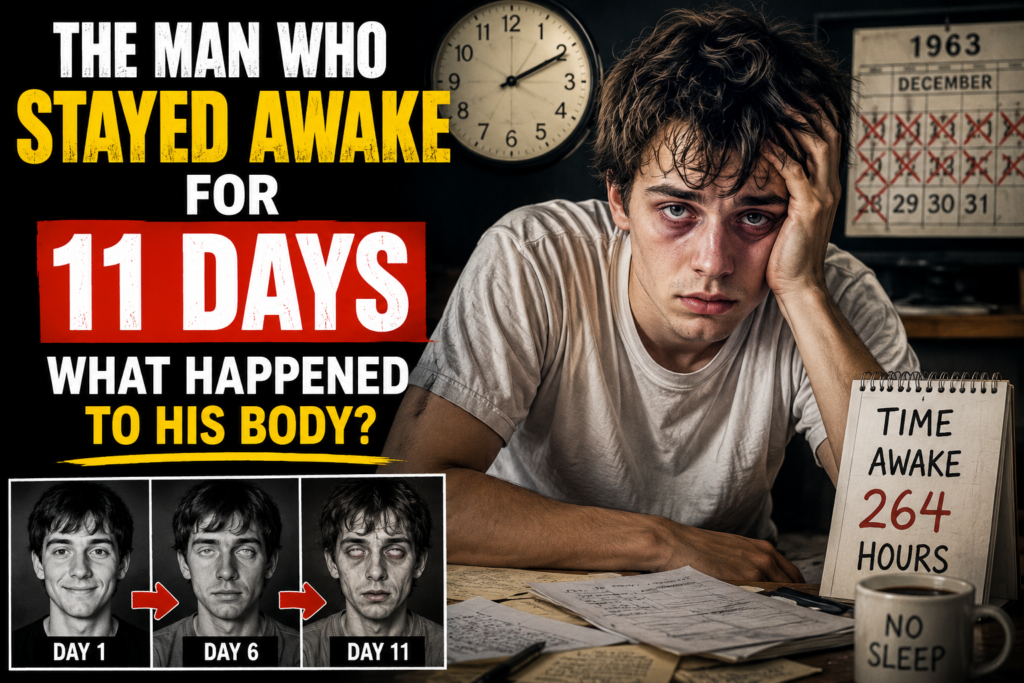

In December 1963, a 17-year-old high-school student from San Diego decided to attempt something that now sounds extremely dangerous: he would stay awake for as long as possible.
His name was Randy Gardner, and what began as a school science project soon became one of the most famous sleep-deprivation experiments in history.

For approximately 264 hours—just over 11 consecutive days—Randy avoided sleep. As the hours passed, his concentration weakened, his mood changed and his ability to understand the world around him began to break down.
By the end of the experiment, Randy had demonstrated something far more important than teenage determination: the human brain cannot function normally without sleep.
Why Did Randy Gardner Stay Awake for 11 Days?
Randy Gardner was a student at Point Loma High School in San Diego, California. In late 1963, he and his classmates were looking for an interesting science-fair project.
Randy and his school friend Bruce McAllister reportedly decided to study the effects of sleep deprivation. The original idea was to examine how staying awake would affect mental abilities, physical performance and everyday behavior.
At the time, the publicized record for staying awake was approximately 260 hours. Randy decided that he would try to remain awake long enough to exceed it.
The experiment began on December 28, 1963, during the school holidays. Randy was just 17 years old.
Two classmates, Bruce McAllister and Joe Marciano Jr., helped keep him awake and recorded changes in his condition. As the experiment attracted increasing attention, Stanford sleep researcher Dr. William Dement became involved. Randy’s health was also monitored by Lieutenant Commander John J. Ross, a medical researcher from the United States Navy.
The First Day: Everything Seemed Normal
During the early hours, Randy reportedly remained active and confident.
He talked with friends, listened to music, played games and moved around to prevent himself from falling asleep. At first, the experiment may have felt more like a difficult challenge than a serious health risk.
However, sleep pressure naturally increases the longer a person remains awake. Even after one night without sleep, people may experience:
- Slower reaction times
- Difficulty concentrating
- Irritability
- Reduced coordination
- Poor decision-making
- Short-term memory problems
Randy was only at the beginning of an experience that would become progressively harder.
Day Two: His Eyes and Brain Began to Struggle
After roughly two days without sleep, Randy reportedly began having difficulty recognizing objects by touch.
His eyes also struggled to focus properly. He became increasingly sensitive, tired and irritable.
At this point, staying awake was no longer simply a matter of determination. His body was strongly demanding rest, while his friends had to keep him active through conversation, games, walks and other activities.
Caffeine and other stimulant drugs were reportedly not used as part of the documented experiment. This is one reason Randy’s case became especially interesting to sleep researchers.
Day Three: Mood Changes and Poor Coordination
As the third day arrived, Randy’s mood reportedly became more unstable.
He could become cheerful and energetic at one moment, then irritated or uncooperative shortly afterward. His physical coordination also began to decline.
Tasks that would usually be simple required more concentration. His speech, attention and memory were becoming less reliable.
These changes showed that sleep deprivation was not merely making him feel tired. It was affecting how his brain processed information and controlled behavior.
Medical summaries of the case describe significant impairment in concentration, motivation, perception and higher-level mental functioning during the experiment.
Day Four: Randy Began Hallucinating
By around the fourth day, Randy reportedly began experiencing hallucinations.
In one widely repeated incident, he imagined that he was a famous American football player. He also reportedly mistook an ordinary street sign for a person.
Hallucinations occur when someone sees, hears or senses something that is not actually present. Severe sleep deprivation can interfere with the brain’s ability to distinguish between imagination and reality.
Randy’s brain was now working under extreme pressure. Although his eyes remained open, his interpretation of the environment was becoming unreliable.
Day Five: Memory Problems Became More Serious
After several days without sleep, Randy had increasing difficulty remembering recent events.
He could begin a task and then forget what he was doing. He struggled to stay focused during conversations and tests.
His ability to form and retrieve short-term memories had weakened considerably.
This is one of the reasons sleep is essential for students and working adults. During sleep, the brain processes information, supports learning and helps organize memories. Without sufficient rest, even basic mental activities can become surprisingly difficult.
Randy’s experience illustrated that someone may appear awake while their mental abilities are seriously impaired.
Days Six and Seven: Paranoia and Confusion
As Randy entered the second half of the experiment, reports described periods of confusion, irritability and paranoia.
Paranoia involves unreasonable suspicion or the belief that other people may be acting against you. Randy reportedly became suspicious of those monitoring the experiment and sometimes resisted their attempts to test him.
His condition was not constant. At certain moments, he could communicate normally or perform well in a game. At other times, his concentration, perception and emotional control were severely affected.
This inconsistency is part of what makes sleep deprivation dangerous. A person may briefly feel alert and believe that they are functioning normally, even when their judgment and reaction times remain impaired.
Could Randy Have Experienced Microsleeps?
One difficulty in measuring extreme wakefulness is the possibility of microsleeps.
A microsleep is a very brief episode of sleep that may last only a few seconds. A person’s eyes may remain open, and they may not even realize that they briefly lost awareness.
Because brain-monitoring equipment was not continuously attached to Randy throughout every moment of the experiment, researchers cannot completely rule out the possibility that he experienced brief microsleeps.
This is also why claims about extreme periods without sleep can be difficult to verify scientifically. A person may genuinely believe that they remained awake continuously while experiencing several unnoticed sleep episodes.
Day Ten: He Could Still Play Pinball
One of the most surprising details from the experiment occurred near the tenth day.
Despite his extreme sleep deprivation, Randy reportedly managed to beat sleep researcher William Dement at pinball.
This incident has sometimes been used to suggest that Randy remained healthy and mentally capable throughout the experiment.
However, being able to perform one familiar or exciting activity does not mean that the brain is functioning normally. Stimulating activities can temporarily increase alertness, while difficulties may still appear during memory, attention and reasoning tests.
Medical observer John J. Ross reported serious cognitive and behavioral effects, including mood changes, memory problems, concentration difficulties, paranoia and hallucinations.
Day Eleven: He Forgot What He Was Doing
On the final day, Randy was given a simple mental task.
He was asked to begin at 100 and repeatedly subtract seven. He reached 65 and then stopped.
When researchers asked why he had stopped, Randy reportedly said that he had forgotten what he was supposed to be doing.
This moment clearly demonstrated how severely his working memory and concentration had been affected.
By then, Randy had remained awake for approximately 264 hours and 25 minutes, or about 11 days. His experiment exceeded the previous publicized record and became one of the best-documented cases of prolonged voluntary sleep deprivation.
What Happened When Randy Finally Went to Sleep?
After completing the experiment, Randy attended a press conference before finally being allowed to sleep.
He reportedly slept for approximately 14 hours and 40 minutes during his first recovery sleep.
Surprisingly, he did not sleep continuously for several days. After waking naturally, he remained awake for much of the following day and later slept again.
Researchers observed changes in the structure of his recovery sleep. His brain appeared to prioritize certain deeper and rapid-eye-movement sleep stages rather than simply replacing every lost hour.
Over the following days, Randy’s attention, memory and general cognitive function reportedly returned close to normal. Follow-up examinations at the time did not identify obvious permanent neurological damage from the experiment.
That does not mean the experiment was safe.
Did the Experiment Cause Permanent Damage?
For many years, Randy’s story was presented as evidence that a person could survive extreme sleep deprivation without permanent harm.
However, that conclusion should be treated carefully.
The experiment involved only one person, and Randy was a healthy 17-year-old under active observation. His experience cannot predict how another person’s body might respond.
Decades later, Randy said that he developed serious insomnia in adulthood. He reportedly believed that his sleep problems might have been connected to the experiment, although a direct medical link has not been conclusively established.
Extreme sleep deprivation may increase the risk of accidents, impaired judgment, mood disturbance and serious physical or mental health consequences. It should never be attempted as a challenge or personal experiment.
Does Randy Gardner Still Hold the World Record?
Randy’s experiment is often described as the record for the longest scientifically documented period of intentional wakefulness without stimulant drugs.
However, other people later claimed longer periods.
For example, Maureen Weston reportedly stayed awake for more than 18 days during a rocking-chair marathon in 1977. Other unofficial claims have also been reported.
Comparing these attempts is difficult because monitoring methods differed and unnoticed microsleeps could not always be excluded.
Guinness World Records eventually stopped recognizing or accepting attempts for the longest time without sleep because of the health risks involved.
Therefore, Randy’s 11-day experiment remains famous not necessarily because no one has ever claimed to stay awake longer, but because it was closely observed and became an important historical case in sleep research.
What Happens to the Body Without Sleep?
Randy Gardner’s experience showed how lack of sleep can gradually affect multiple parts of human functioning.
The Brain
The brain becomes less effective at maintaining attention, storing memories, solving problems and making decisions.
Mood
Sleep deprivation may cause irritability, anxiety, emotional instability and suspicious thinking.
Perception
Severe sleep loss can cause visual distortions, hallucinations and difficulty interpreting the environment.
Coordination
Reaction times become slower, making activities such as driving extremely dangerous.
Immune and Physical Health
Sleep supports immune function, hormone regulation, metabolism and cardiovascular health. Continued sleep loss can place significant stress on the body.
Judgment
One of the most dangerous effects is that sleep-deprived people may not accurately recognize how impaired they have become.
The Lasting Lesson of Randy Gardner’s Experiment
Randy Gardner began his experiment as a curious teenager looking for an impressive school project.
Eleven days later, he had become part of scientific history.
He demonstrated that a person might remain physically awake for an extraordinary length of time, but the mind begins losing its ability to function normally long before the body finally stops.
His hallucinations, memory failures, paranoia, mood changes and concentration problems revealed the true cost of prolonged wakefulness.
Randy eventually recovered, but his experience should not be treated as a challenge worth repeating. Modern record organizations no longer encourage sleep-deprivation attempts because the risks are too serious.
The most important lesson from Randy Gardner’s story is simple: sleep is not wasted time. It is one of the basic processes that keeps the human brain connected to memory, judgment, emotion and reality.
Frequently Asked Questions
Who stayed awake for 11 days?
American student Randy Gardner stayed awake for approximately 264 hours in 1963 and 1964 as part of a school science project.
How old was Randy Gardner during the experiment?
He was 17 years old.
Did Randy Gardner hallucinate?
Reports from the experiment describe perceptual distortions and hallucinations, including imagining that he was a famous football player and misidentifying objects.
How long did Randy sleep afterward?
His first recovery sleep reportedly lasted approximately 14 hours and 40 minutes.
Did he suffer permanent brain damage?
Researchers at the time did not report obvious permanent neurological damage, but one person’s recovery does not make extreme sleep deprivation safe.
Can someone safely stay awake for 11 days?
No. Extreme sleep deprivation can seriously impair memory, judgment, perception, coordination and mental health. It should never be attempted.