
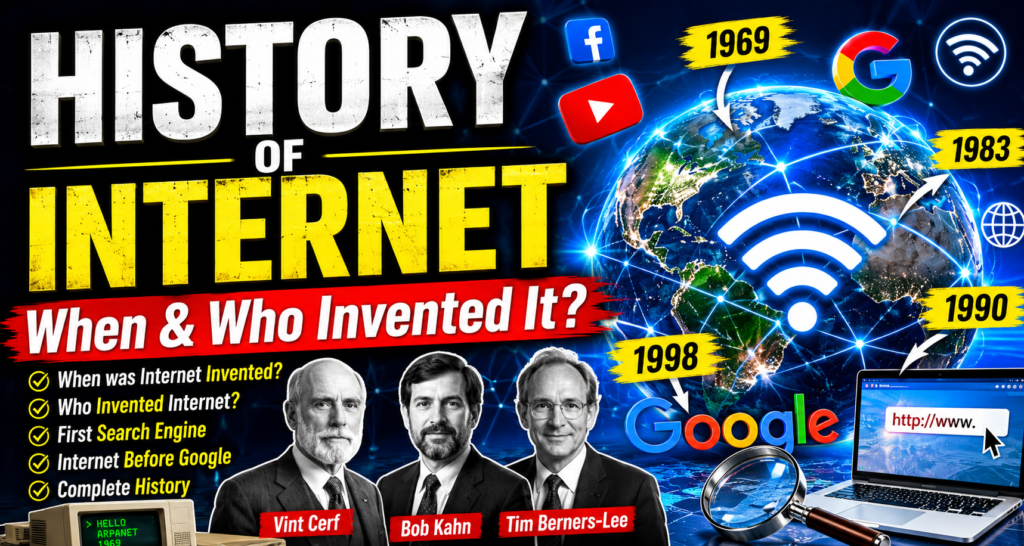

The internet has become one of the most important inventions in human history. Today, we use it for searching information, watching videos, running businesses, online shopping, social media, education, banking, marketing, and communication. But many people still ask one simple question: When was the internet invented, and who invented it?
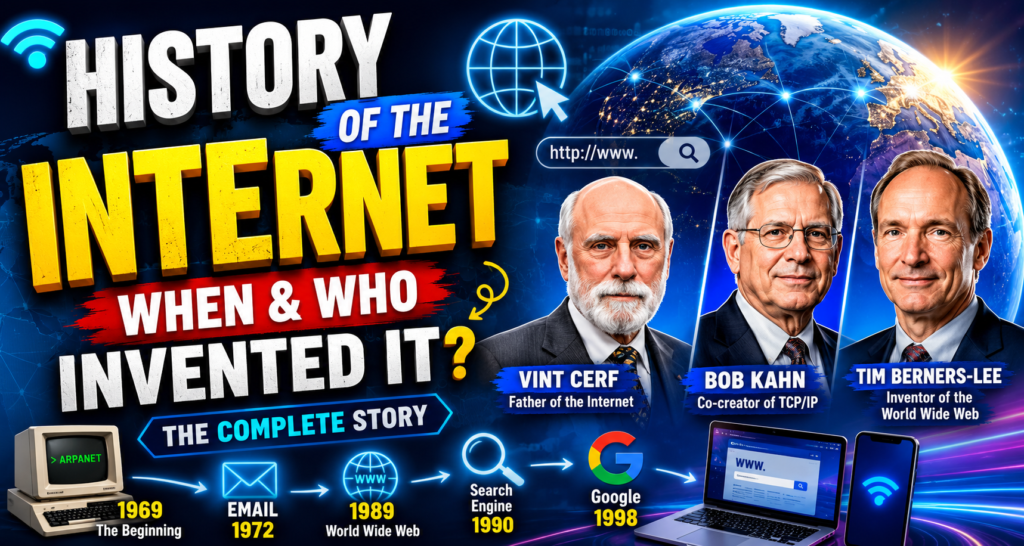
The answer is interesting because the internet was not invented by only one person. It was developed step by step by scientists, engineers, universities, and research organizations over many years. The internet started as a research network and later became the global system we use today.
What Is the Internet?
The internet is a worldwide network of computers connected together. It allows people, businesses, schools, governments, and websites to share information from one place to another. In simple words, the internet is the system that connects devices globally.
Many people think the internet and the World Wide Web are the same, but they are different. The internet is the main network, while the World Wide Web is the system of websites and web pages that we open through browsers.
When Was the Internet Invented?
The early history of the internet started with a project called ARPANET. ARPANET was developed in the United States to connect research computers at universities and institutions. The first ARPANET message was sent on October 29, 1969, which is considered one of the biggest milestones in internet history.
At that time, the internet was not available for normal public use. It was mainly used by researchers, scientists, and government-funded organizations. Computers were large, expensive, and difficult to use, so only selected institutions had access.
A major turning point came on January 1, 1983, when ARPANET officially moved to the TCP/IP system. TCP/IP stands for Transmission Control Protocol / Internet Protocol. This system allowed different computer networks to communicate with each other, and this is why 1983 is often called the birth year of the modern internet.
Who Invented the Internet?
The internet was created by many people, but the two most important names are Vint Cerf and Bob Kahn. They designed the TCP/IP protocols, which became the foundation of the modern internet. Because of their work, computers on different networks could exchange information properly.
However, we should not forget ARPANET researchers and engineers who worked before TCP/IP. The internet was not a single invention like a light bulb or telephone. It was a combination of networking technology, packet switching, protocols, and years of research.
So, the simple answer is:
The internet was mainly developed through ARPANET, and Vint Cerf and Bob Kahn are widely known as the fathers of the internet because of TCP/IP.
What Was ARPANET?
ARPANET was the first major computer network that helped create the idea of the internet. It was funded by ARPA, which was part of the U.S. Department of Defense. The purpose was to connect computers at different research centers so they could share data and resources.
In the beginning, ARPANET connected only a few universities. But it proved that computers could communicate over long distances using packet switching. Packet switching means breaking information into small pieces, sending those pieces through a network, and joining them again at the destination.
This idea became the foundation of internet communication.
How Did People Use the Internet Before Google?
Before Google, the internet was very different. There were no modern search pages, no YouTube, no Facebook, no Instagram, and no easy mobile browsing. People used the internet mainly for:
1. Email Communication
Email was one of the earliest and most useful internet tools. It allowed researchers and users to send text messages to each other quickly. The Internet Society notes that email became an important ARPANET application in 1972.
2. File Sharing Through FTP
FTP, or File Transfer Protocol, was used to upload and download files from remote computers. Users had to know server addresses and file names. It was not as simple as clicking a download button today.
3. Remote Login
Users could connect to another computer from far away using tools like Telnet. This was common among researchers and technical users.
4. Online Forums and Discussion Groups
People used discussion boards, mailing lists, and early forums to ask questions, share ideas, and discuss technical topics.
5. Direct Website Addresses
Before powerful search engines, users often typed exact website addresses or used directories to find information.
In short, the early internet was useful but not user-friendly. It required technical knowledge, patience, and manual searching.
Internet vs World Wide Web
The World Wide Web made the internet easier for normal people. British scientist Tim Berners-Lee invented the World Wide Web in 1989 while working at CERN. His goal was to help scientists share information easily through linked documents.
The first website was also created at CERN, and CERN still preserves information about the birth of the web and the first website.
This changed everything. After the web, people could open pages, click links, and move from one document to another. This was the beginning of the website-based internet that we know today.
Which Search Engine Came First?
The first internet search engine was Archie. It was created by Alan Emtage at McGill University. Archie helped users find files stored on FTP servers. McGill University describes Archie as the first internet search engine.
Archie was not like Google. It did not search full web pages or understand normal questions. It searched file names from FTP archives. Still, it was a major step because it helped people find information faster than manual searching.
After Archie, more search tools and directories appeared, including Veronica, Jughead, Yahoo Directory, AltaVista, Lycos, Excite, and Ask Jeeves. These platforms helped users find websites before Google became popular.
When Did Google Start?
Google came much later. Larry Page and Sergey Brin started Google as a research project at Stanford University. Google Inc. was officially born in August 1998, according to Google’s own company history.
Google became popular because it gave more accurate search results. Its PageRank system analyzed links between websites to understand which pages were more useful and trustworthy. This made Google faster and better than many older search engines.
Why Did the Internet Become So Popular?
The internet became popular because it solved real problems. It made communication faster, information easier to access, and business more scalable. Over time, internet speed improved, websites became easier to use, and mobile phones brought the internet into everyone’s hands.
Today, businesses use the internet for SEO, digital marketing, lead generation, e-commerce, social media, online ads, and brand growth. A business without a strong online presence can easily lose customers to competitors.
Conclusion
The internet was not invented in one day or by one person. Its early journey started with ARPANET in 1969, and the modern internet began in 1983 with TCP/IP. Vint Cerf and Bob Kahn played a major role in building the foundation of the internet, while Tim Berners-Lee invented the World Wide Web in 1989. Archie was the first internet search engine, and Google arrived later in 1998.
From a small research network to a global digital world, the internet has completely changed how people live, learn, communicate, and grow businesses.